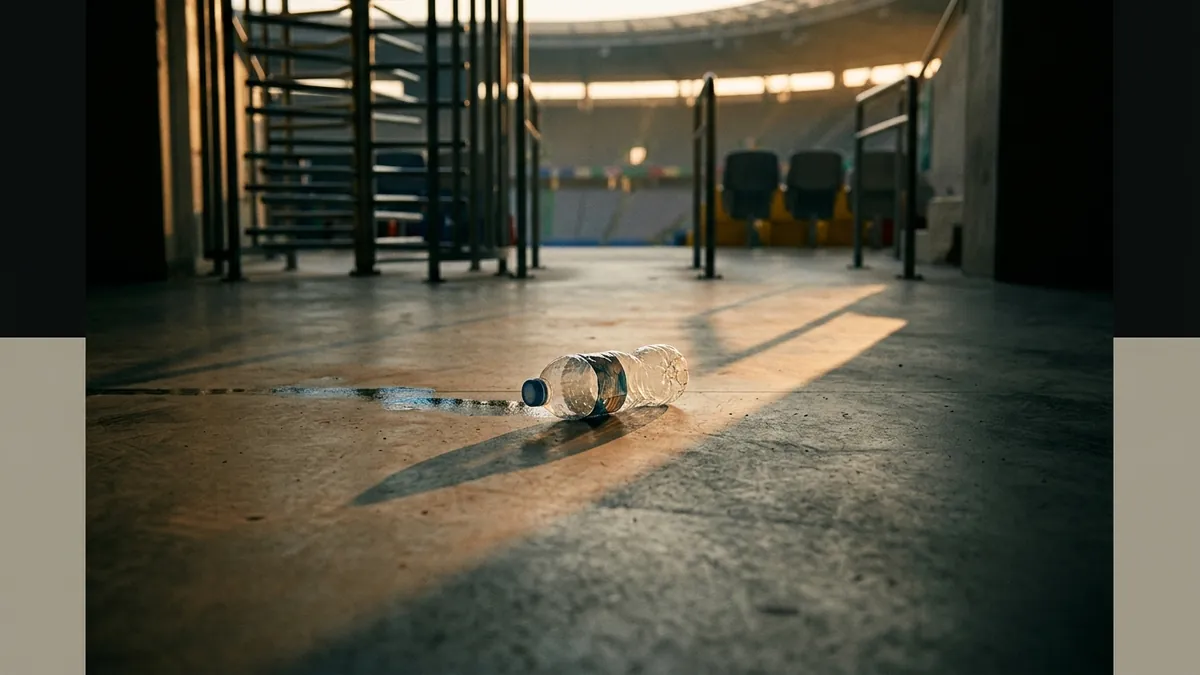
Seven days before the opening match in Mexico City, FIFA quietly rewrote what fans can carry through the turnstiles. Refillable plastic bottles, the kind every supporter assumed was fine, are now on the banned list at all 104 matches across the United States, Canada and Mexico. The policy lands in the middle of a forecast heatwave across several host cities. One supporter quoted by Sky News asked, dryly, what was next. Sun cream?
It is a small operational story with a big logistical tail. FIFA's reasoning, broadly, is security and concession control. The reaction from fan groups has been less broadly anything. With group stage matches in Dallas, Houston, Monterrey and Kansas City likely to kick off in conditions north of 35°C, the optics of charging stadium prices for the only legal source of water are, to put it mildly, unhelpful.
Deposit $20, get $50 to trade
Welcome bonus on the world's largest prediction market.
18+ · New users only · Availability and terms vary by region · Trading involves risk of loss · BeGambleAware.org
What the ban actually changes
The practical effect is narrow. Fans can still bring an empty hard-sided bottle through security, refill it at fountains inside, and carry it to their seat. What they cannot do is bring water in. For a tournament where the average ticket holder will queue in direct sun for an hour before kickoff, that distinction matters more than FIFA's press line suggests.
The heat angle is the part worth flagging. Several host venues have no roof and minimal shade. Mexico City sits at altitude. Monterrey routinely hits the high thirties in June. The Estadio Azteca opener on 11 June, the Mexico match that effectively launches the tournament, is scheduled for a midday kickoff window. None of this is news to FIFA. None of it is news to the broadcasters either, who have been quietly lobbying for evening slots that the time zone maths simply does not allow.
What is genuinely new is the timing. A policy change seven days out, after fans have already bought flights and made plans, is the sort of thing that erodes goodwill without obviously buying FIFA anything in return. Stadium concession contracts are presumably part of the calculation. They usually are.
Why the winner market on Polymarket has not flinched
Here is the interesting bit. None of this shows up in the prices. France still sits at 17.05% on Polymarket, Spain at 15.95%, England at 11.45%. Those numbers have barely twitched in the week running up to the announcement, and they should not, because a water bottle policy does not change who wins a football tournament.
But heat does. Sort of. There is a thin argument that extreme conditions favour squads with deeper rotation options and disadvantage teams reliant on a single creative player running ninety minutes at full tilt. Argentina, carrying a 38-year-old Lionel Messi who is confirmed in the final squad as captain (a minor hamstring scare aside, he is expected to be fit), sits at 8.95%. That number has not moved on heat concerns either. The market, broadly, is treating environmental variables as already priced.
That is probably right. Qatar 2022 was played in air-conditioned bowls. Russia 2018 had its own heat moments. The teams that have historically struggled in hot-weather tournaments are not the favourites here. Brazil at 8.25% under Carlo Ancelotti, taking the Seleção to his first World Cup as their head coach, are arguably the team best prepared for the conditions. Spain's high-press game is the one that should theoretically suffer most, and Spain are second favourites.
The gap between the operational story and the market story is the lesson. FIFA can change policy at the last minute, fans can be furious, broadcasters can grumble, and the implied probabilities driving the winner market can sit perfectly still because none of it is information about who plays football better than whom.
What would actually move the price
A confirmed Messi withdrawal would move Argentina. A serious injury to Kylian Mbappé, who Polymarket has at 16% to win the Golden Boot, would move France. A heat-related match postponement, which FIFA has the authority to call but has not signalled, could in theory move several markets at once if it pushed a knockout fixture into a less favourable slot for a specific contender. None of those are on the table this morning.
The water bottle ban, for all the noise, is the kind of story that fills column inches and moves nothing on the order book. It is worth knowing about because it tells you something about how FIFA is approaching the tournament. It is not worth trading on, because the link between concession policy and ninety minutes of football is, in technical terms, nil.
What might be worth watching is the secondary effect. If conditions inside stadiums become genuinely dangerous and fans start leaving matches early, the political pressure on FIFA escalates fast. That is a story for week two, not week one. iPredicta is tracking the World Cup 2026 markets we carry on Polymarket, and we will be flagging any movement that ties to on-the-ground conditions rather than to the football itself.

Frequently asked questions
Does an off-pitch story like a water bottle ban ever move prediction market prices?
Rarely, and almost never on the main winner markets. Operational policies, fan complaints, and broadcaster grumbles tend to be noise rather than signal. What does move prices is information that changes the probability of one team beating another: confirmed squad changes, injuries to marquee players, or a fixture being moved or postponed in a way that affects the schedule of a specific contender.
How can I tell whether a news story is priced in already?
Watch the price action in the hours around the story breaking. If the implied probability barely moves, the market either thinks the news is irrelevant or thinks it was already factored in. France sitting still at 17.05% on Polymarket through the FIFA announcement is a good example. The volume of trading during a non-event is often more informative than the headline itself.