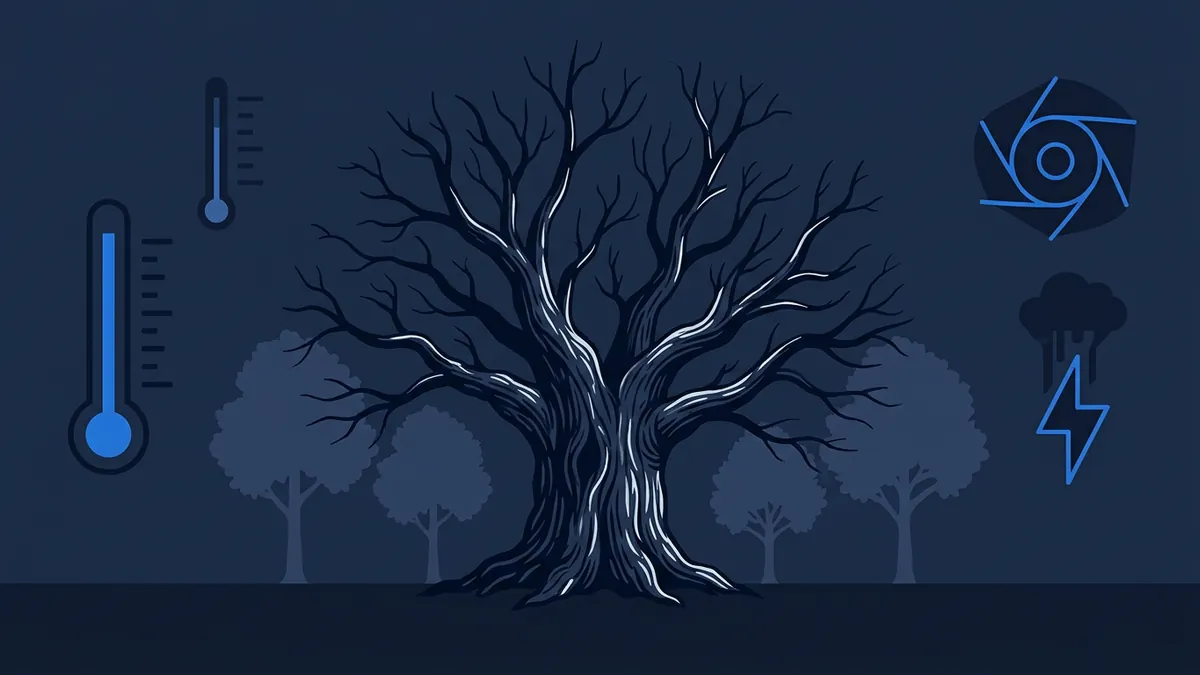
For roughly a thousand years, the Major Oak in Sherwood Forest produced leaves every spring. This year it did not. The tree, one of the oldest and largest in Europe, has been declared dead after a run of hot, dry summers left it too stressed to leaf, reported by the Guardian.
A single oak dying is not, by itself, a market event. But it sits inside one. The climate pressure that finally pushed the Major Oak past recovery is the same pressure being priced, year by year, on the 2026 global temperature ranking market on Polymarket, where traders are sorting bets on exactly how hot this year will land in the historical record.
Deposit $20, get $50 to trade
Welcome bonus on the world's largest prediction market.
18+ · New users only · Availability and terms vary by region · Trading involves risk of loss · BeGambleAware.org
What the ranking market is actually pricing
The contract is narrow and mechanical. It asks where 2026 will rank against every prior year in NASA's Global Land-Ocean Temperature Index, with 1 being the hottest year ever recorded, 2 the second-hottest, and so on down. Resolution happens once the data prints, so traders are not arguing about whether climate change is real. They are arguing about a single integer.
As of 18 June, the market has a clear lean. Traders put 2026 finishing second-hottest at 67%, with the outright hottest-year-ever outcome at 24%. Everything else is rounding error: third place at 3%, fourth at 4%, fifth under 1%, and the catch-all "6 or lower" at 4%. The contract has taken roughly $3M since it opened, though 24-hour turnover is negligible. A slow, thinly-traded climate market that reprices through the summer as monthly data lands.
The takeaway from that distribution is not subtle. Roughly nine in ten dollars on the book sit on 2026 finishing either first or second. The argument is not whether this year will be near the top of the all-time list. It is which of the two podium steps it lands on.
Why one tree connects to a global ranking
Individual ancient trees do not show up in NASA's temperature dataset. The Major Oak is not a data point on the index, and its death will not shift the ranking by a thousandth of a degree. The connection runs the other way.
The index measures one of the pressures that killed the tree. The reporting frames the cause as a compounding combination of soil compaction from millions of visitors and a run of hot, dry summers. Ancient oaks with shallow root systems relative to their crown cannot endure that combination indefinitely. The compounding heat and drought is the climate signal expressed through biology, alongside the human pressure of being one of Sherwood Forest's most-visited specimens.
Prediction markets cannot tell you whether a specific oak will leaf next April. They can tell you, with a probability attached, what the broader temperature trend underneath that oak looks like. For readers new to the format, our explainer on how prediction market odds translate into probabilities walks through the mechanics. The Polymarket ranking is one of the more legible climate contracts in the wild precisely because it resolves on a single, audited number.
What the market cannot tell you
It is worth being honest about the limits. The contract resolves on a rank, not a temperature. A second-place finish in 2026 could still be hotter, in absolute terms, than the first-place year it sits behind, depending on how the deltas land. Rank-order markets compress information.
The other limit is causation. A 67% lean toward second place is not a claim about what caused any specific weather event in any specific forest. Traders are aggregating views on global averages, not local stressors. The Major Oak died in Nottinghamshire; the index averages the planet. The two are linked through climate, not through the contract itself.
And the figures move. Heat ranking markets reprice through the summer as monthly data lands, and the 67% on second place today reflects what traders know on 18 June, not what they will know in October when more of the year is in the books. We cover the broader question of why prediction markets tend to be accurate aggregators elsewhere, with the usual caveats about thin contracts and slow-moving data.
The editorial take
The Major Oak's death is a story about loss, and it should be read that way first. A tree older than the Magna Carta, gone in a single spring because the summers got too hard. That is not a market story. It is an obituary.
The market story is the context underneath it. Polymarket's 2026 ranking contract is, in effect, a continuously updated odds line on the climate trend that the oak's death sits inside. Traders are pricing 2026 as almost certainly a top-two year, with the only live disagreement being which of the two. For a reader trying to understand whether this year's heat is anomalous or simply the new pattern, that distribution does a job no individual news story can do on its own.
iPredicta tracks climate and environment contracts across Polymarket and the regulated US venues, and the 2026 heat ranking market is exactly the kind of slow-burn signal that rewards watching over months rather than reacting day-to-day.

Frequently asked questions
How does the 2026 heat ranking market actually resolve?
It resolves on NASA's Global Land-Ocean Temperature Index, which ranks every year for which there is data from hottest to coldest. Once the figure for 2026 is published, the market pays out whichever rank outcome matches, and ties resolve to the place the tied year occupies. Later revisions to the data do not change the resolution.
Why is the market so confident 2026 will be first or second?
Roughly 91% of the contract's value sits on the top two outcomes as of 18 June, with second place at 67% and first at 24%. That reflects the data traders already have from the first half of the year combined with the recent run of record-warm years; the remaining outcomes for third place or lower carry only a few percent each.