You cannot trade on Polymarket or Kalshi from the UK. That has been true since both platforms launched, and it will stay true for at least another twelve months. The interesting question is why, and what that tells you about what a UK-legal prediction market will look like when one eventually arrives.
The short version: there is no blanket ban on prediction markets as a category. What exists is an older FCA rule on binary options that was written before any of these platforms reached scale. Prediction market contracts happen to fit the definition of a binary option almost exactly, so the rule catches them. This is an accident of structure rather than a considered policy position on event contracts. It matters because it shapes what any UK launch will have to look like: a regulated betting exchange, not a financial product.
Two points worth making up front. UK users are not without options, Betfair Exchange has been running peer-to-peer political markets since 2000 and remains the deepest-liquidity venue in the country for that kind of trading. And the regulatory gap between the US and UK models is narrowing faster than most retail observers expect. Kalshi processed $23.8 billion in nominal trading volume in 2025, up 1,108% year on year. Robinhood's event contracts became its fastest-growing product line by revenue over the same period. Numbers of that size tend to move regulators.
What follows covers where UK law actually sits, which platforms you can use today, and the three signals to watch over the next year. This is an educational guide, not legal or financial advice. Always verify the current terms of any platform before sending real money, and confirm your own position if you are unsure.
Deposit $20, get $50 to trade
Welcome bonus on the world's largest prediction market.
18+ · New users only · Availability and terms vary by region · Trading involves risk of loss · BeGambleAware.org
The short answer: Polymarket and Kalshi are geoblocked for UK users
Visit Polymarket from a UK IP address and the site loads in what it calls "view-only mode." You can browse markets, read prices, see volumes. Try to connect a wallet or place a trade and a modal appears listing the blocked regions, the United Kingdom sits on that list alongside the United States, Germany, France, and a few dozen others. Kalshi is blunter about it. Attempt to sign up from the UK and you get a flat message: "Trading on Kalshi is not available in your country," with the UK at the top of the prohibited list.
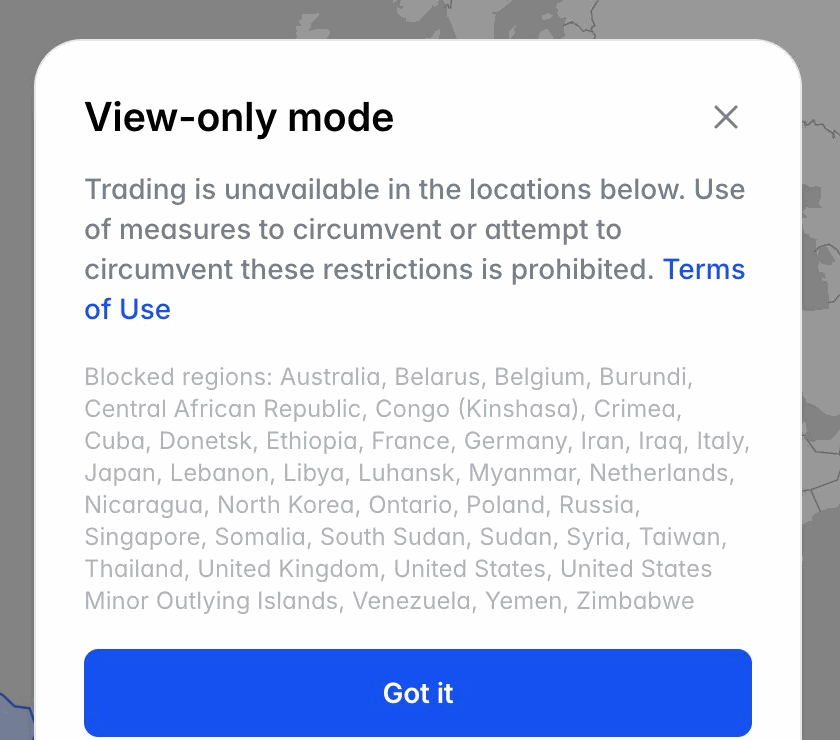
Polymarket's restricted jurisdictions list includes the UK alongside the US, Germany, France, Australia, Belgium, Italy and the Netherlands. Kalshi is available in over 140 countries and is blocked in several dozen, the UK among them. Both geoblocks are deliberate and both are essentially permanent under the current rules.
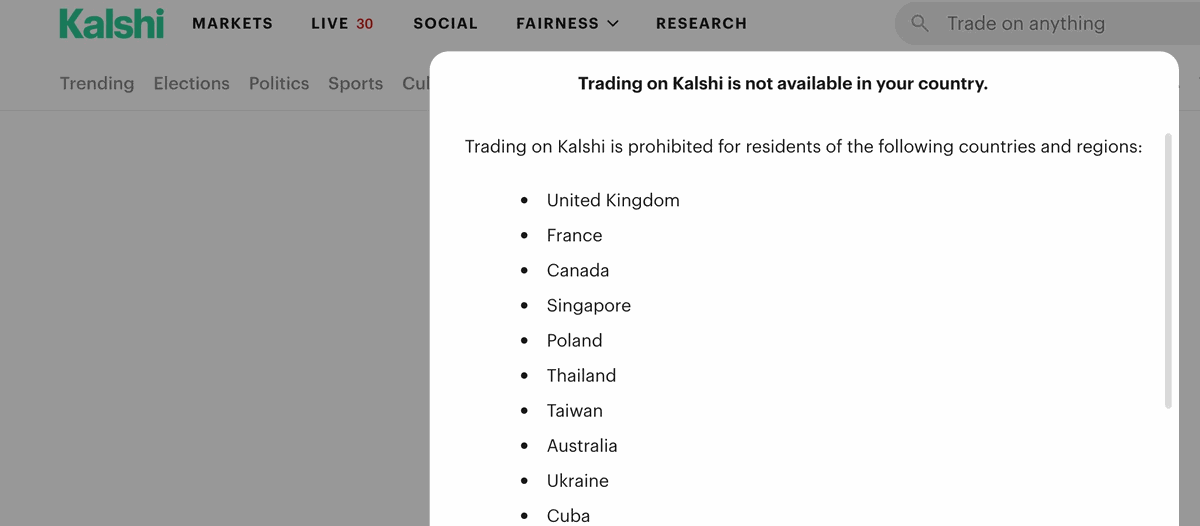
This is not oversight. It is a calculated response to UK financial regulation that predates prediction markets by several years, and neither company has found a structure that makes a UK retail launch workable inside the current regime. Both have said publicly they would like a route in. Neither has one yet.
Why the ban exists: the FCA, 2019, and the binary options fight
The relevant rule dates from March 2019. The Financial Conduct Authority made permanent a temporary ban it had introduced the previous year, prohibiting the sale, marketing and distribution of binary options to retail consumers in the UK. The FCA's published rationale was blunt: binary options, in its view, were "gambling products dressed up as financial instruments." The FCA estimated its permanent ban could save retail consumers up to £17 million a year, alongside its wider finding that the large majority of retail customers lost money on these products.
Prediction market contracts use a binary option structure at their core. A "Yes" contract pays £1 if the event occurs and nothing if it does not. The trading price between those two extremes reflects market-implied probability. Viewed from the FCA's 2019 framework, that structure is a binary option. Reasonable people can and do argue this conflates two different products, but the regulation does not.
This is why Polymarket and Kalshi cannot simply extend into the UK. Doing so would put them in direct conflict with the retail ban. The only lawful route to offering binary-style event contracts to UK retail users is through the gambling framework, which means a UK Gambling Commission licence rather than FCA authorisation.
The UK Gambling Commission view
The UKGC has been consistent. Its stated position is that prediction market operators, subject to the specifics of each business model, would appear to fall within the definition of a "Betting Intermediary" under the Gambling Act 2005. In plain terms: prediction markets are gambling, not finance, for UK regulatory purposes.
This is a meaningful split from the US approach. There, the Commodity Futures Trading Commission treats event contracts as commodities-style financial derivatives regulated under the Commodity Exchange Act. The same product is a financial derivative under one regime and a bet under another. Which framework wins in a given country determines which regulator licenses the platform, which consumer protections apply, and which tax treatment the user gets. These are not minor distinctions.
The UKGC has not yet issued dedicated guidance on prediction markets as a specific product category. That is widely expected to change as international platforms push for UK entry and as the Gambling Act reforms progress through Westminster. When it arrives, that guidance will do more than anything else to determine what a UK-legal prediction market looks like, the licensing requirements, the advertising restrictions, the affordability checks, the market types permitted.
What UK users can legally use today
The product gap is real, but it is not total. Several UKGC-licensed betting exchanges already offer something close to the Polymarket and Kalshi experience, and for political markets specifically the UK has one of the deepest liquidity pools in the world. The interfaces are different. The underlying mechanism is almost identical.
Betfair Exchange and Betfair Predicts
Betfair Exchange has operated in the UK since 2000. It is the clear liquidity leader among UK-licensed peer-to-peer betting platforms and covers sports, politics, entertainment, and a range of specials. For political prediction markets it is, by volume, the most active venue in the country.
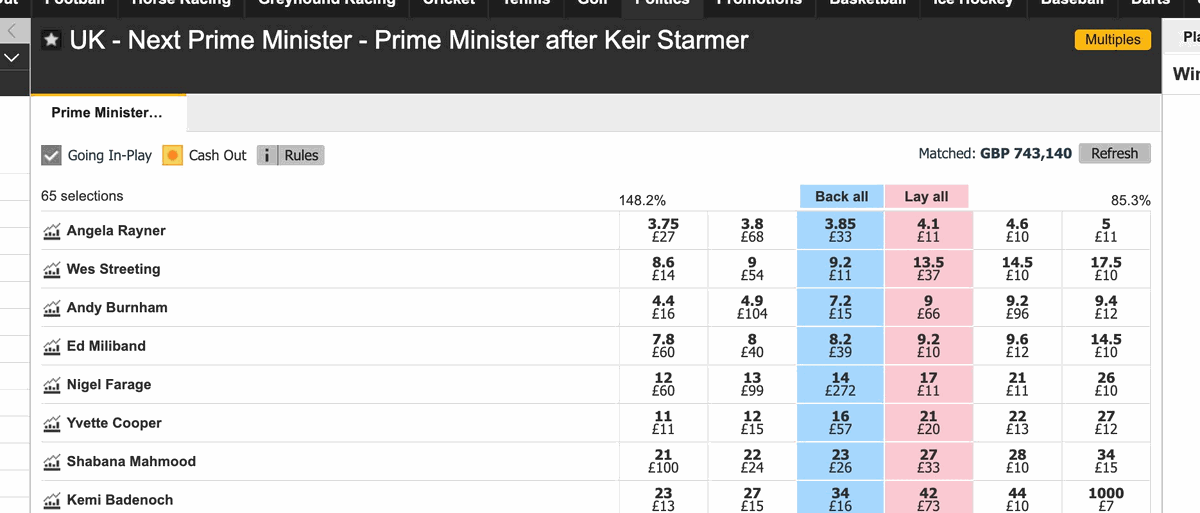
In April 2026 Betfair soft-launched Betfair Predicts to a small invite-only beta. The product is effectively a re-skinned interface over the existing Exchange that presents contracts in the familiar Yes/No format Polymarket and Kalshi users will recognise. Same underlying liquidity, different UI. Because it sits on the existing Betfair UK licence, it is legal for UK retail users from day one. Wider rollout is expected through the course of 2026.
The commission structure is the one complaint worth flagging. Betfair charges 5% on winnings by default. Betfair replaced that Premium Charge with the Expert Fee in January 2025, set from gross profit over your last 52 active weeks: nothing up to £25,000, 20% between £25,000 and £100,000, and 40% above that, so a consistently profitable account pays materially more than the headline rate. Retail participants rarely hit the premium threshold, but the headline 5% is noticeably above Smarkets.
Smarkets
Smarkets is a London-based betting exchange, UKGC-licensed, and the main challenger to Betfair on fees. Commission is 2% of net winnings with no premium charge, which matters if you trade frequently. Market coverage includes politics, current affairs, sports, and a growing roster of event contracts. Smarkets has also been quietly building out a US presence, which suggests the team takes prediction-market-style products seriously as a strategic direction.
The real limitation is liquidity. Order books on most markets are thinner than Betfair, which translates into wider spreads and harder fills at size. For smaller retail positions this rarely matters. For anything more serious it does.
Matchbook
Worth watching. Matchbook is a UKGC-licensed exchange that announced in 2025 it would launch what it described as the first true UK prediction markets platform, a standalone product, not a re-skin of an existing exchange. Target launch is 2026, and Matchbook has also floated the possibility of licensing its technology stack to other UK operators. Neither commitment has landed yet, but both are worth tracking.
Spreadex
A niche case. Spreadex offers spread betting on financial markets and sports, and for retail users who meet the FCA's professional trader criteria the platform can provide access to binary-style derivatives. Those criteria, income, trading history, portfolio size, disqualify the overwhelming majority of retail users. For completeness: this route exists, but it is not practically available to most people reading this.
The regulatory direction of travel
Three developments matter over the next twelve months.
The first is formal UKGC guidance. Several senior UKGC staff have signalled that dedicated prediction-markets guidance is on the roadmap, driven largely by the volume of inbound interest from US-based platforms. Whether that guidance is permissive (clear licensing route, proportionate affordability checks, reasonable market-type permissions) or restrictive (onerous additional requirements on top of the standard betting licence) will shape the UK market for years. The permissive version unlocks Polymarket-style products under UKGC supervision. The restrictive version entrenches Betfair and Smarkets as the only viable venues.
The second is the Gambling Act reforms currently progressing through Westminster. The reforms started as a broad review of the 2005 Act and have already produced changes on affordability, advertising, and loot-box treatment. The final text will determine whether prediction markets are explicitly brought inside the regulatory perimeter as a named product category, or whether they continue to be treated case-by-case through existing betting-intermediary rules. Expect the final version to land within 12 to 18 months.
The third is external pressure from the US. Kalshi's $23.8 billion in 2025 trading volume, up 1,108% year on year, and roughly $11 billion valuation make it hard to ignore. Polymarket returned to the US market in November 2025 with full federal approval after a multi-year ban, and in October 2025 the Intercontinental Exchange, owner of the New York Stock Exchange, agreed to invest up to $2 billion in the platform at a valuation of around $8 billion, becoming a global distributor of Polymarket's data to institutions. Robinhood's event contracts became its fastest-growing product line by revenue, with more than 11 billion contracts traded by over a million customers in 2025. When that much regulated capital and activity flows into a product category, other major jurisdictions, including the UK, tend to revisit their position on it.
What this means in practice
If you are a UK retail user interested in prediction-markets-style trading today, Betfair Exchange is your best available option. For political markets specifically it has both the deepest liquidity and the widest market coverage. Betfair Predicts, once it rolls out more broadly, will close most of the UX gap with Polymarket. Smarkets is a credible alternative if you are sensitive to commission and trading at a scale where thinner liquidity is not a blocker.
If you are waiting for a UK-native prediction markets product with the full Polymarket feature set, crypto markets, global geopolitical events, rapid market creation, open APIs, that product does not yet exist in the UK. Matchbook's 2026 launch is the clearest candidate. A Polymarket or Kalshi UK entry is possible but will require either a regulatory unlock or a materially different product structure. Neither is likely inside twelve months.
If you are curious about how the UK's regulatory treatment evolves, two signals are worth tracking. The UKGC's first formal guidance on prediction markets will set the tone for the entire market. The final Gambling Act text will set the legal framework underneath that guidance. Both are plausible inside the next 12 to 18 months.

How iPredicta fits in
iPredicta is a prediction markets discovery and intelligence platform built for UK users first, and for other regulated markets as they open. We do not operate an exchange. What we do is help you see what is actually available to you, which platforms you can legally use from your location, how the odds and spreads compare across Betfair and Smarkets on the markets you care about, and where the sharpest pricing sits on any given contract.
When a new UK-native prediction market launches, Betfair Predicts at scale, Matchbook's 2026 product, or whatever follows, we will be the layer that compares them honestly so you can choose where to trade. And as the regulatory picture clarifies, we will track what changes, when, and what it means for UK users specifically. That is the role we think UK prediction markets need filled, and it is the one we are building.
Frequently asked questions
Is Polymarket legal in the UK?
Polymarket blocks UK users from trading. The site loads in view-only mode and you can browse markets, but attempting to connect a wallet or place a trade triggers a country-restriction modal listing the United Kingdom alongside the US, Germany, France, and around forty other jurisdictions. The block exists because prediction-market contracts use a binary-option payout structure, and the FCA banned the sale of binary options to UK retail consumers in March 2019.
Is Kalshi legal in the UK?
Kalshi explicitly excludes UK residents. The platform is available in over 140 countries and is blocked in several dozen, with the United Kingdom listed first on its prohibited countries page. Attempt to sign up from a UK IP address and you get a flat notice stating that trading on Kalshi is not available in your country. The regulatory reason is the same as Polymarket: prediction-market contracts conflict with the FCA's binary-options retail ban.
What prediction markets can I legally use in the UK?
Several UKGC-licensed betting exchanges offer products that are mechanically very similar to prediction markets. Betfair Exchange is the deepest-liquidity option, particularly for political contracts, and has operated in the UK since 2000. Smarkets is the main challenger and charges 2% commission compared to Betfair's 5%. Matchbook announced in 2025 that it would launch the first dedicated UK prediction-markets platform in 2026. None of these are labelled as prediction markets under UK law, they are betting exchanges, but the underlying mechanism is essentially identical.
Why are prediction markets banned in the UK?
They are not banned as a category. The relevant restriction is an FCA rule from March 2019 that prohibited the sale, marketing, and distribution of binary options to retail consumers. Prediction-market contracts use a binary-option structure at their core, a Yes contract that pays £1 if the event occurs and nothing if it does not, so they fall within the rule by accident of structure rather than by direct policy. UK-licensed betting exchanges can offer mechanically similar products under the gambling framework instead.
Will prediction markets become legal in the UK?
Likely, though probably through the gambling framework rather than the financial one. The UK Gambling Commission is widely expected to issue dedicated guidance on prediction markets within 12 to 18 months, and the broader Gambling Act reforms currently progressing through Westminster will determine whether the category is brought formally inside the regulatory perimeter. International pressure from Kalshi and Polymarket's growth in the US is also a factor. The most likely outcome is UK-licensed prediction markets operating under UKGC supervision, not FCA-regulated event contracts.