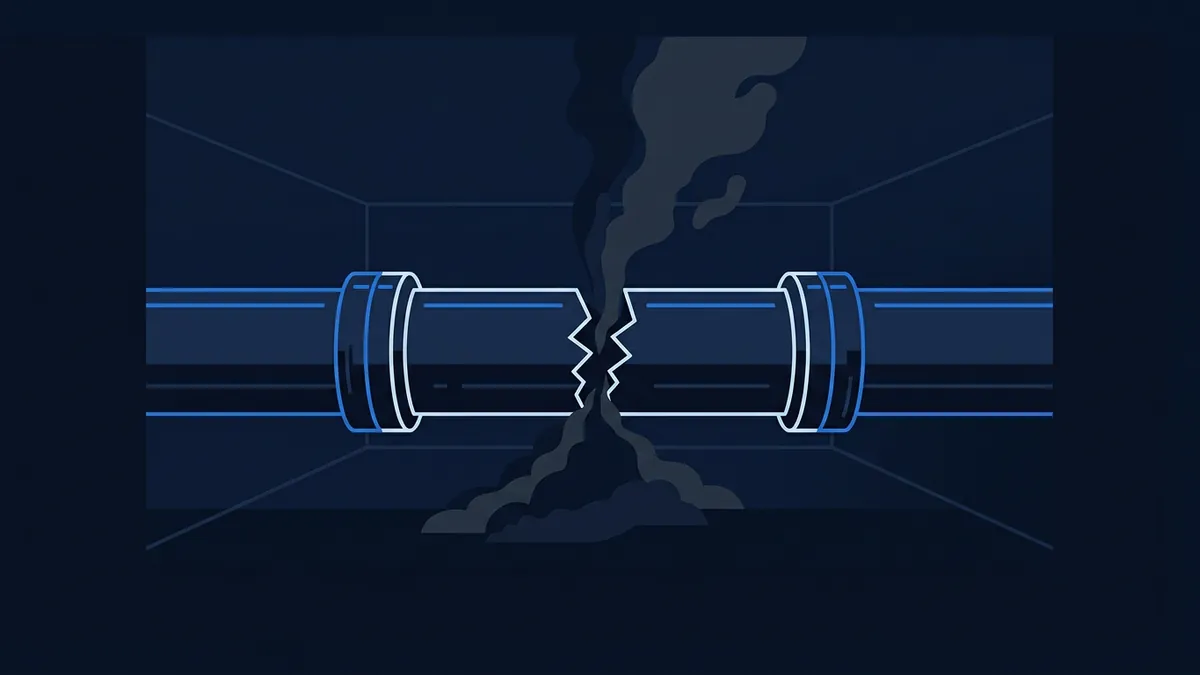
Germany's federal prosecutors have finally put a name to the Nord Stream case, and the name is Ukrainian. The BBC reports that a Ukrainian national has been charged over the September 2022 blasts that severed the pipelines under the Baltic. Kyiv denies any involvement. The diplomatic subtext, as the BBC frames it, is that the case could carry serious consequences for the Ukraine-Germany relationship at a moment when neither side can afford it.
On Polymarket, the contract on Nord Stream restarting before 2027 barely twitched. No sits at 97%, up a fraction on the day. Yes trades at 3%. That is not a market that is waiting to be persuaded.
Deposit $20, get $50 to trade
Welcome bonus on the world's largest prediction market.
18+ · New users only · Availability and terms vary by region · Trading involves risk of loss · BeGambleAware.org
What the contract actually asks
The question is narrower than the politics around it. The market resolves Yes only if any line of Nord Stream 1 or Nord Stream 2 is delivering natural gas in commercial quantities to Germany or another EU member state by the end of 2026. Test flows do not count. Symbolic transfers do not count. The bar is sustained, measurable supply, the kind that would show up in end-user distribution figures.
That framing is doing a lot of work. It strips out the mood music (talks, thaws, gestures) and asks only whether real gas is moving through real pipe. On that test, the market has effectively said no for months. The charge announced this week did not shift the price, because the price already reflected the physical and political reality: three of the four Nord Stream lines were ruptured, the infrastructure remains damaged, and even a repaired pipe would need a political decision in Berlin to open the valve.
Both of those conditions look further away today than they did a week ago, not closer. If how prediction market odds work tells you anything, it is that a 97/3 split is not the market hedging its bets. It is the market saying the residual 3% is essentially the cost of writing the ticket.
Why the charge tightens rather than loosens the picture
The intuitive read is that identifying a Ukrainian suspect somehow clears the path: Russia was not the saboteur of its own export infrastructure, so surely the pipe can eventually flow again. The market is telling you the opposite, and the mechanics are worth spelling out.
For Nord Stream to deliver commercial gas by December 2026, several things need to happen in sequence. The damaged lines need repair, which is a multi-year marine engineering job on infrastructure sitting in contested Baltic waters. Germany needs to want the gas, which means a domestic political decision to re-open a Russian supply route that the current governing coalition spent two years unwinding. And the EU sanctions architecture around Russian pipeline gas needs to permit the flow, or be dismantled.
A Ukrainian suspect in a German court does not accelerate any of that. If anything, it complicates the German end of the equation. Berlin now has to prosecute a citizen of a country it is arming and funding, over an attack on infrastructure that Berlin itself paid to build. That is not a diplomatic environment in which anyone in the Bundestag wants to be seen advocating for Russian gas to flow again.
The contract is priced accordingly. This is a useful case study in what these markets are good for: cutting through the narrative around a headline and asking a mechanical question with a mechanical answer. For a broader sense of why prediction markets are accurate on questions like this, the honest read is that they price the boring physical bottlenecks that op-eds tend to skip past.
The 3% is not a hedge, it is a floor
One trap worth flagging. When a contract sits at 97/3, the natural instinct is to read the 3% as "the market thinks there is a 3% chance." That is roughly true, but the more useful frame is that 3% is close to the practical floor for any binary contract that is not literally resolved yet. It reflects the small residual probability of a genuine surprise (a lightning ceasefire, a change of government, a sudden repair announcement) plus the cost of holding a No position through 18 months of headline risk.
The move today, up a fraction on No, is on light volume for a market of this shape. Turnover in the last 24 hours is modest. That matches the pattern of a contract where the answer is broadly settled and traders are trickling in to lock in yield on the No side rather than fighting over the direction. The news is real, but it is confirming what the price already implied.
Worth watching, but only just. The contract that would actually move on a Nord Stream story is one asking about a specific German political shift, or a specific repair announcement, not the umbrella question of whether gas flows again.
iPredicta tracks the Nord Stream contract alongside the wider set of European energy and Ukraine-Russia markets, because the interesting information is usually not in the headline number, it is in which contracts move and which ones, like this one, stay pinned when they arguably should not.

Frequently asked questions
Does the charge announced this week change the probability of Nord Stream restarting?
Not meaningfully. The polymarket.com contract barely moved in 24 hours and remains at 97% No. The barriers to a restart are physical (three ruptured pipeline sections in the Baltic) and political (a German coalition that has spent two years pivoting away from Russian gas), and a criminal charge does not shift either of those.
What exactly does the market need to see for a Yes resolution?
Sustained, measurable commercial gas flow through any line of Nord Stream 1 or 2 into Germany or another EU member state by 31 December 2026. Symbolic transfers, pressure tests and one-off flows do not count. The resolution source is a consensus of credible reporting on actual end-user supply.