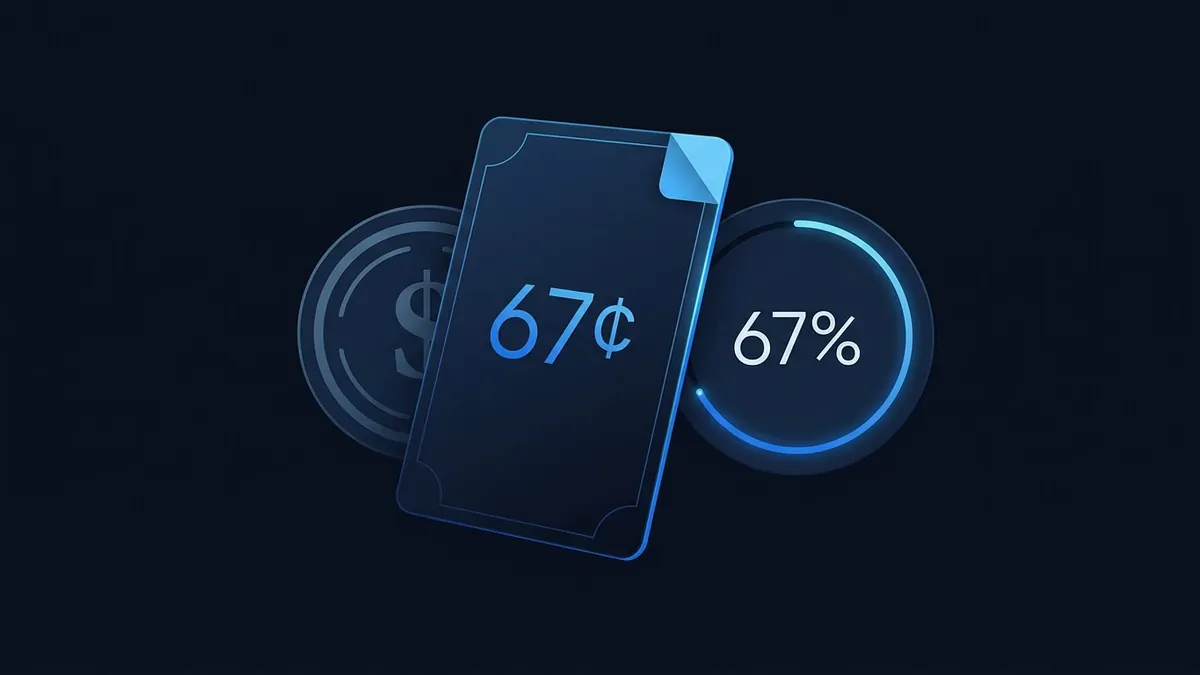
Open Polymarket or Kalshi for the first time and the first thing that stops you is the prices. They are quoted in cents, between zero and one hundred. A contract on "Will the Bank of England cut rates in June?" might say 34¢. The one next to it might say 71¢. (Every price in this guide is an illustration, not a live quote.)
If you have never traded a prediction market before, that is genuinely confusing. Cents per what? What are you actually buying? And why does the screen say "34% chance" next to a price of 34 cents: is that a coincidence, or is it the same number?
It is the same number. Once you see why, the rest of the platform clicks into place. If you want the higher-level introduction first, our explainer on how prediction markets work covers the foundations. Otherwise, here is the version that takes five minutes.
Deposit $20, get $50 to trade
Welcome bonus on the world's largest prediction market.
18+ · New users only · Availability and terms vary by region · Trading involves risk of loss · BeGambleAware.org
The one-dollar contract
A standard prediction market contract on Polymarket or Kalshi pays one dollar if the event happens and nothing if it does not. A Yes share pays out when the event happens; a No share is the mirror image, paying out when it does not.
That fixed payout is the whole trick. Because the most a share can pay is a dollar, the price you pay for it is the market's implied probability of the event.
If the market thinks there is a 60 per cent chance Liverpool wins the Premier League, the share for "Liverpool wins" trades at 60 cents. Pay 60 cents now, get a dollar back if you are right: your profit is 40 cents. If you are wrong, you lose the 60 cents you paid.
There are rare exceptions, and each market's rules say when they apply. If a Polymarket market cannot be resolved clearly, for example because the event is cancelled, it can resolve 50-50, and every share then pays 50 cents whichever side it backed. Kalshi can instead settle a market at a fair price taken from its trading, for example when a player does not take part. For the ordinary contract, though, it is one dollar or nothing.
Why prices equal probabilities
Imagine you and a friend disagree about a coin flip. You think it is a fair coin and offer to bet at 50 cents. He thinks it is biased toward heads and is willing to pay 55 cents to bet on heads. The price the two of you settle on is the price at which neither of you can find a better deal, and that price is, in expectation, the probability of heads.
Scale that up to thousands of traders, and the price of a contract is the price at which buyers and sellers stop disagreeing. If new information arrives, a poll moves, a player is injured, a central bank speaks, the price moves until a new equilibrium is found. That equilibrium is the market's probability estimate at that moment, held in place by money rather than published as an opinion.
This is why traders treat the price as a probability. It is not a perfect measure: markets can be moved by thin trading, manipulation or bias, as the section on distortions below explains.
Converting a price to a probability
The translation itself is simple. A price of 63 cents implies a 63 per cent probability. A price of 8 cents implies 8 per cent. A price of 50 cents is a coin flip. Read the cents as a percentage.
The more useful skill is reading the pair. On a binary market, Yes and No between them cover every outcome, so their prices sit close to a dollar in total. If Yes is 63 cents, No should be about 37. If the quotes add up to more than a dollar, say Yes offered at 63 and No offered at 39, the extra two cents is the bid-ask spread: the cost of trading, not free money. You cannot buy both sides at those prices and lock in a profit. Our guide to Yes shares and No shares walks through the mechanics, and our guide to prediction market arbitrage explains why the gap is rarely a real opportunity.
The honest single number is the mid-price. If Yes is bid at 62 and offered at 64, the implied probability is 63 per cent, not 62 or 64. Polymarket's own displayed price works this way: it shows the midpoint of the best bid and offer, unless that spread is wider than 10 cents, in which case it shows the last traded price instead.
How this compares with bookmaker odds
Bookmaker odds describe the same idea, implied probability, in a different format, and with the bookmaker's margin built in. To turn decimal odds into a probability, divide one by the odds: decimal odds of 1.59 imply about 63 per cent. Fractional odds of 4/7 are decimal 1.57, about 64 per cent.
Add up the implied probabilities of every outcome in a bookmaker's market and the total comes to more than 100 per cent. The excess is the overround, the bookmaker's margin. A sportsbook pricing both sides of a coin-flip event at decimal 1.91 implies about 52.4 per cent on each side, about 105 per cent in total, and you have to strip that margin out before the number is a clean probability.
A prediction market has no overround to strip out. Traders match against each other, so the two sides of a binary contract sum to about a dollar by construction rather than by the venue's choice. That does not make it free: Polymarket and Kalshi both charge trading fees on most markets, and a fee pushes what you effectively pay away from the probability in the same direction a margin does. Our side-by-side page on Kalshi vs Polymarket fees shows what each venue charges.
Reading Polymarket
On Polymarket the price is shown as a probability, with a chart of how it has moved and an order book underneath showing the prices people are willing to buy and sell at. If Yes is offered at 67¢ and bid at 65¢, the market is calling it 65 to 67 per cent, and the two cents between them is the spread, your friction cost if you trade. On a thin market that gap can be several cents, and you should treat the headline number with scepticism. Our full guide on how to read Polymarket odds goes further.

Reading Kalshi
Kalshi is a US exchange designated by the CFTC as a contract market in November 2020. Its prices are quoted in cents, from 1 to 99, and a contract at 34¢ on Kalshi works exactly like a Polymarket contract at the same price: the maths is identical, the wrapper is not. Our guide on how to read Kalshi odds covers the platform in detail, and our piece on how to compare Polymarket and Kalshi walks through the practical differences.

Where implied probability misleads
The price is only as good as the traders willing to move it. Three distortions are worth knowing.
Thin markets. A market with little money behind it can be moved a long way by a single determined buyer. The implied probability is real in the sense that it is the current price, but it is fragile, and it does not carry the weight of a price set by heavy trading. Our primer on liquidity explains why thin markets deserve a pinch of salt.
The favourite-longshot bias. Cheap contracts on unlikely events have tended to win less often than their price implies, and expensive contracts on likely events slightly more often. A 2026 study of more than 300,000 Kalshi contracts by economists at University College Dublin found that low-price contracts win far less often than they need to in order to break even after fees, while high-price contracts yield small positive returns. Earlier research on prediction markets found the same bias, strongest in markets a long way from their closing date. A very cheap contract can be a lottery ticket priced above its odds.
Resolution risk. If there is any ambiguity about how a market resolves, the price drifts away from the probability of the underlying event. A contract on whether a politician "visits" a country, with no clean definition of a visit, settles on a price that reflects both the event and the disagreement about what counts. The price is the market's read on the contract, not on the underlying question. Our primer on market resolution covers the mechanics.
What to actually do with the number
The price is a probability. Treat it like one. If you believe the true probability is 75 per cent and the contract is trading at 60, you and the market disagree by 15 points, before fees and the spread are counted.
That is how to read the number, not a reason to trade on it. The read cuts both ways: if your estimate sits far from the price, either you have found something or the market knows something you do not. Experienced traders assume the second until they have evidence otherwise.
Watch the tails. A favourite drifting from 92 cents to 88 cents looks like a small move. In probability terms the long-shot outcome has gone from 8 per cent to 12 per cent, half as likely again. The price moved a little; the forecast moved a lot.
Common mistakes
Treating the price as binary. A 70¢ contract is not "going to win". It is being priced as a 70 per cent chance, so three times out of ten, in expectation, it loses.
Ignoring the spread. On thin markets the spread can eat any edge you think you have. If you pay 67¢ to enter and the market is bid at 60¢, you have given up seven cents of value before anything has happened.
Forgetting fees. Polymarket and Kalshi both charge trading fees on most markets. Bake them into your expected value, or trades that look like winners will quietly lose money.

The takeaway
Prediction market odds are not a different language. They are the same probability your weather app shows when it gives the chance of rain, expressed in cents and tradable. Once you read prices as probabilities, the platforms stop being intimidating and start being useful. iPredicta surfaces live prediction market data from both venues so you can see the price, and the implied probability, without juggling tabs.
A natural follow-up is our piece on prediction markets versus polls, on why these prices and the polling consensus often differ.
Correction, 2 October 2026. An earlier version of this guide said a contract always pays one dollar if the event happens ("Always one dollar. Always."). That is the standard case, not a rule without exceptions. A Polymarket market that cannot be resolved clearly can resolve 50-50, paying 50 cents a share whichever side it backed, and Kalshi can settle a market at a fair price taken from its trading. The explanation, the FAQ and the image caption have been corrected.
Frequently asked questions
How do prediction market odds work?
A standard contract pays one dollar if the outcome happens and nothing if it does not, so the price you pay is the market's view of the probability. A contract trading at 67 cents means the market puts the chance at 67 per cent. In rare cases a market settles differently: a Polymarket market that cannot be resolved clearly can pay 50 cents a share, and Kalshi can settle a market at a fair price taken from its trading.
How do I convert a prediction market price to a probability?
Read the price in cents as a probability in per cent: a Yes share at 63 cents implies a 63 per cent chance the event happens. If the Yes and No quotes do not add up cleanly to a dollar, use the mid-price between the bid and the offer, which strips out the spread.
Are prediction market odds the same as betting odds?
They describe the same thing, implied probability, in different formats. A 63 per cent probability is decimal odds of about 1.59. Bookmakers build a margin into their odds, so their implied probabilities add up to more than 100 per cent; a prediction market's prices are set by traders matching each other, though trading fees still apply.
Why do Yes and No prices not always add up to $1?
Between them, Yes and No cover every outcome of a binary market, so their prices sit close to a dollar. When the quotes add up to more, the difference is the bid-ask spread, the cost of trading. You cannot buy both sides at those prices and profit, because the offer is what you pay. Markets with more than two outcomes, and thin markets with one side of the book nearly empty, can look further out.
Can prediction market odds be wrong?
Yes. The price is the current consensus of traders with money at stake, and that consensus can be biased, herd-driven or uninformed. Thin markets can be pushed by one trader, very cheap contracts have tended to win less often than their price implies, and ambiguous resolution rules pull prices away from the underlying probability. Treat the price as informed, not as certain.
Why do the same event's prices differ across platforms?
Different venues attract different traders and different amounts of money, and their rules on how a contract resolves can differ. The same election might sit at 41 cents on Polymarket and 44 on Kalshi because the two pools of money are only loosely connected. A gap usually reflects a difference in liquidity, in how each venue's rules word the resolution, or in who is allowed to trade there, which is why each venue's terms matter as much as its price.