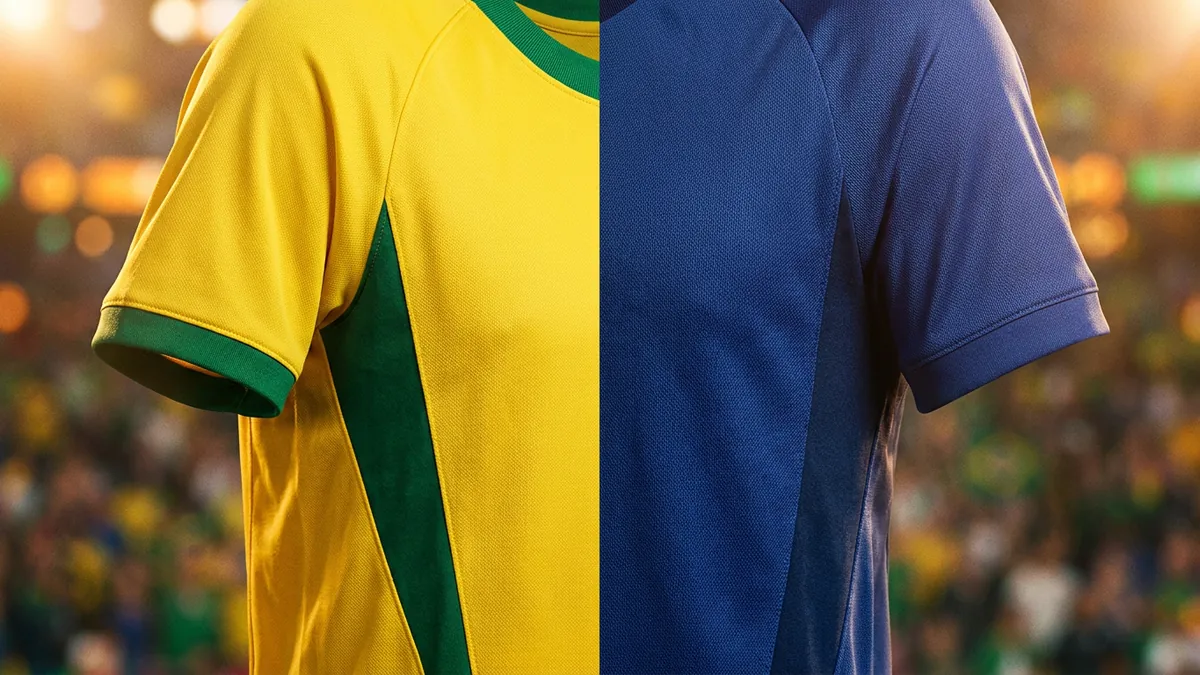
Tsuneyasu Miyamoto picked his words carefully when he told reporters this weekend that Monday's tie with Brazil could be the biggest match in Japan's footballing history. The Japan FA president was not selling tickets. He was naming the stakes of a Round of 32 fixture that, on paper, Japan are not supposed to win, and on Polymarket, are not priced to win either.
The Brazil vs Japan match contract on Polymarket has Brazil at 58% as of 28 June, with the draw at 26% and Japan at 19%. The 24-hour rolling turnover is healthy for a single fixture, which is what you would expect when one of the historical heavyweights of the tournament meets a Group F side that already held the Netherlands and went the distance with Sweden. The market has picked a favourite. It has not picked a runaway.
Deposit $20, get $50 to trade
Welcome bonus on the world's largest prediction market.
18+ · New users only · Availability and terms vary by region · Trading involves risk of loss · BeGambleAware.org
What 58, 26, 19 is actually saying
The first thing to notice is the shape. Brazil's 58% is a clear lead, not a coronation. The draw on 26% and Japan on 19% together make up the rest, and a knockout fixture that goes to extra time and penalties resolves under whatever rules the contract specifies, which here is the upcoming Round of 32 game as a single named event. Read the resolution mechanics carefully before betting; "Japan wins" and "Japan progresses" are not always the same line on a knockout match book.
Brazil's 58% is the kind of number a market gives a side it broadly trusts but cannot fully back. The squad context is Carlo Ancelotti's first World Cup as Brazil head coach, a break from the federation's tradition of domestic appointments, and a group stage where they were held by Morocco and laboured past the smaller sides. Vinicius Junior, Raphinha, Bruno Guimaraes, Marquinhos and Alisson Becker are all in the 25, and they remain the spine of a side priced at 8% to win the whole tournament outright. That outright price is the wider context for the 58% on Monday: this is a team the market believes in just enough to favour, not enough to write the knockout off as procedural.
Japan's 19% is the more interesting number. It is not a token. A one-in-five chance is what you give a team that genuinely can win the fixture if a single thing breaks their way, not a no-hoper getting a polite floor. Wataru Endo anchors the midfield, Takefusa Kubo and Ritsu Doan carry the threat wide, Daichi Kamada knits it together. They went 2-2 with the Netherlands in the group and were denied by millimetres against Sweden. The market saw all of that. Japan still come in as underdogs because they are underdogs, but the gap is narrower than the seedings would have implied a decade ago.
Why the draw price matters more than usual
The draw at 26% is the contract's most informative leg, and the one casual readers tend to misread. In a knockout match priced as three named outcomes, the draw is the live possibility that ninety minutes ends level. It is not a prediction about who wins extra time or penalties, and it is not a back door for either side. If you want to bet "Japan reaches the quarter-finals", that is a different question from "Japan wins this contract", and a glance at how prediction market odds work will save anyone reading the line as a shootout proxy.
That 26% is also why the favourite price is not higher. Knockout football is structurally tighter than league football; sides that need a result sit deeper, time burns differently, and the draw eats probability mass that would otherwise sit with either team. Brazil's 58% has the draw weighing it down as much as Japan does. A neutral observer should expect that in a single-fixture knockout market.
What the contract can and cannot tell you
The contract is a snapshot, not a prophecy. It tells you what traders are willing to back at the price right now, which on a fixture this close to kick-off is informed by squad fitness, Ancelotti's likely starting XI, the heat at the venue, and any tactical read leaking out of the camps. It does not tell you who will win. It does not tell you how. And it cannot read Miyamoto's framing of the match as Japan's biggest ever as anything other than a comment, because the market only resolves on the outcome, not on whether the rhetoric proves justified.
What is fair to say is that 19% from a market that has watched Japan all tournament is a respectable underdog price, and 58% from a market that has watched Brazil labour through Group C is a tempered favourite price. Reasonable people will look at those two numbers and conclude different things. Some will see Brazil's class as undervalued at 58%; others will see Japan's structure as undervalued at 19%. Both reads are defensible, and that is roughly what an efficient knockout-fixture book is supposed to look like.
Miyamoto's biggest-in-history framing is, as reported by ESPN, a federation president doing his job on the eve of a fixture his side is not expected to win. The price tells a more measured story. Brazil are favoured. Japan are live. The draw is doing more work than usual. iPredicta tracks the World Cup match contracts across Polymarket and the UK-regulated venues, and the Round of 32 ties are the ones worth watching: this is where the small numbers stop being academic and the brackets start to bite.

Frequently asked questions
Does Japan's 19% on Polymarket mean Japan win the tie or Japan progress to the quarter-finals?
It means Japan win the contract as defined, which is the Round of 32 game on 29 June between Brazil and Japan with three named outcomes: Brazil, Draw, Japan. How that maps onto extra time and penalties depends on the contract's resolution wording, so check the market page itself rather than assuming a knockout-progression read.
Why is the draw priced so high at 26% for a knockout match?
Knockout football is structurally tighter than league football, and a single-fixture three-way contract assigns real probability to ninety minutes ending level. The 26% on the draw is part of why Brazil's favourite price sits at 58% rather than higher: the draw eats into both sides' share.