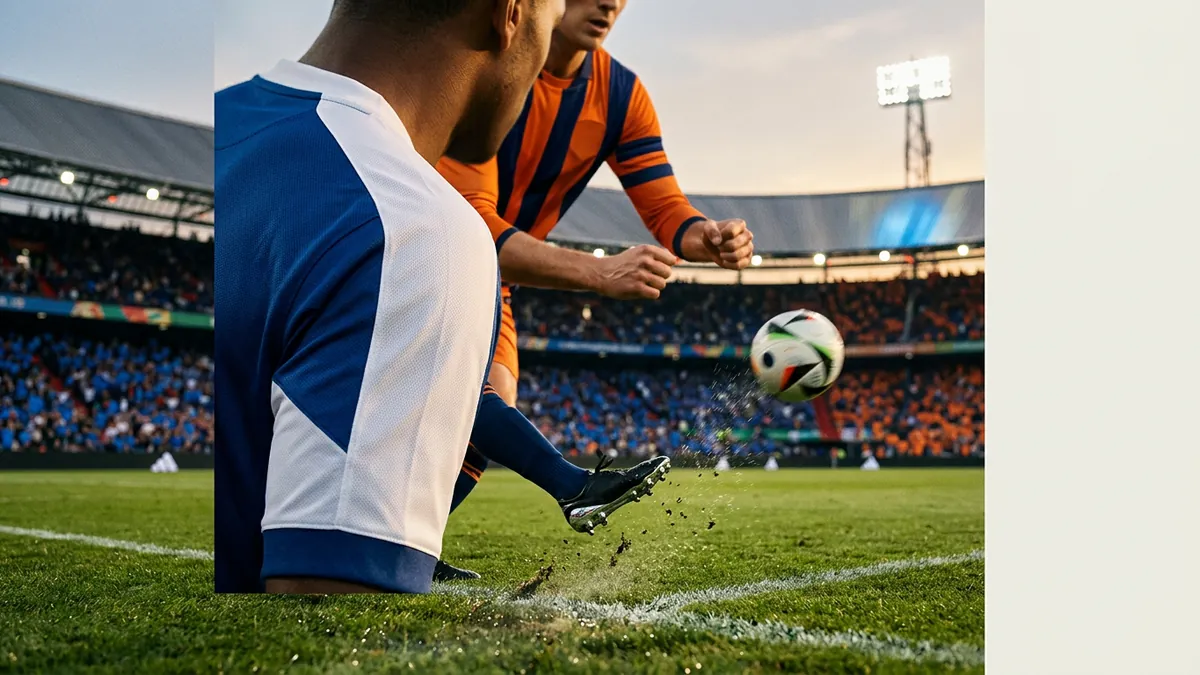
Saturday 13 June, somewhere in Group C, Scotland walk out for their first World Cup match in twenty-eight years against a Haiti side most British supporters could not name three players from. The bookies have a view. So does the crowd on Polymarket. They mostly agree, but not as emphatically as Tartan Army optimism would have it.
The Haiti vs Scotland match market on Polymarket prices Scotland at 64% to win, with the draw at 21% and Haiti at 16%. Roughly $3 million has traded through the contract in the last twenty-four hours. That is real money attaching itself to a fixture that, on paper, ought to be the gentlest possible introduction to Group C, where Brazil and Morocco lurk for whoever survives.
Deposit $20, get $50 to trade
Welcome bonus on the world's largest prediction market.
18+ · New users only · Availability and terms vary by region · Trading involves risk of loss · BeGambleAware.org
A favourite, but a long way from a formality
Scotland at 64% is the market's clear call. Steve Clarke's side is the favourite, and traders nudged that figure up two points in the last day's flow. But 64% is not 100%, and it is the draw and the underdog price that give the fixture its texture. A draw sits at 21%. Haiti at 16% is a live underdog, not a token outcome priced for the sake of completeness.
Put another way: roughly a third of the implied probability sits with "Scotland do not win this match." That is a real number for a side facing a Caribbean opposition ranked well below them. International tournament football has a long, expensively-documented history of teams who were supposed to walk through their opening fixture and instead spent ninety minutes chasing it. Scotland's own history at major tournaments is not exactly a tale of comfortable Group-A nights.
If you want a sense of how to read these numbers without panicking, our explainer on prediction market implied probability walks through what a 64% price actually means. Short version: it is a strong lean, not a guarantee.
Goals: the market expects an open game
The over/under ladder is where the contract gets interesting. Over 1.5 goals trades at 81%. Over 2.5 sits at 60%, and that figure has climbed nine points in twenty-four hours. Both teams to score is priced at 55%, up six points on the day. Over 3.5 is on 36%.
That is a market expecting a properly open match. Not the cagey 1-0 you might pencil in for a favourite trying to manage a group stage. Something with goals at both ends, the underdog landing a punch, the favourite eventually finding the extra gear. The drift in the totals market over the past day, climbing across every threshold, suggests fresh money has been arriving on the side of an entertaining ninety minutes rather than a stifling one.
The over 4.5 price of 19% is the other tell. Nearly a fifth implied for a four-goal-plus margin of football is not where you price a stalemate. It is where you price a game with shape, mistakes, and the possibility of a Scotland team in a hurry.
The scoreboard the market is sketching
On exact scorelines, no single result dominates. The two leading prices are Scotland 1-0 and Scotland 2-0, each at 12%. A 1-1 draw is on 11%. A 2-1 Scotland win sits at 11%. After that the ladder fans out: 3-0 Scotland at 9%, 3-1 Scotland at 8%, and a flat 0-0 still carrying 6%.
That distribution tells a coherent story. The most-priced single outcome is Scotland by a goal or two, but the spread of probability across narrow Scotland wins, the 1-1 draw, and the higher-scoring Scotland results means traders are not committing to a particular flavour of victory. They are committing to Scotland winning, probably narrowly, in a match with a real chance of Haiti scoring. The both-teams-to-score price at 55% mirrors that exactly.
For anyone newer to reading per-outcome contracts like these, our piece on how prediction market odds work is the cleanest place to start. The mechanics matter more than the headline number, especially on a market with this many sub-outcomes.
What it adds up to
The market view, plainly: Scotland should win, the game should have goals, Haiti are likely to find one of their own, and the most probable single result is a tidy 1-0 or 2-0 to Clarke's side. That is the consensus, and it is a fair one. The Tartan Army should arrive optimistic but not complacent. A draw at 21% is the kind of figure that turns from abstract probability into bitter reality often enough to be worth respecting.
With Brazil and Morocco waiting in the same group, anything less than three points from Haiti turns Scotland's tournament into a salvage operation almost immediately. The traders know that. So, presumably, does Clarke. iPredicta is tracking the Group C contracts across the major venues as the matches roll in; this one is the cleanest test of how seriously to take the prices.

Frequently asked questions
What does Scotland at 64% on Polymarket actually mean?
It means the implied probability of a Scotland win, derived from the contract's trading price, sits at 64% as of the snapshot above. That is a clear lean toward Scotland, not a certainty. The draw on 21% and Haiti on 16% absorb the rest of the implied probability.
Why is the over 2.5 goals market priced so close to a coin flip?
Over 2.5 goals at 60% reflects a market expecting an open game rather than a cagey one, but goals markets near three are inherently balanced because the difference between a 2-1 and a 2-0 is one finish. The price drifted up nine points in twenty-four hours, suggesting fresh money is leaning toward entertainment rather than a stalemate.