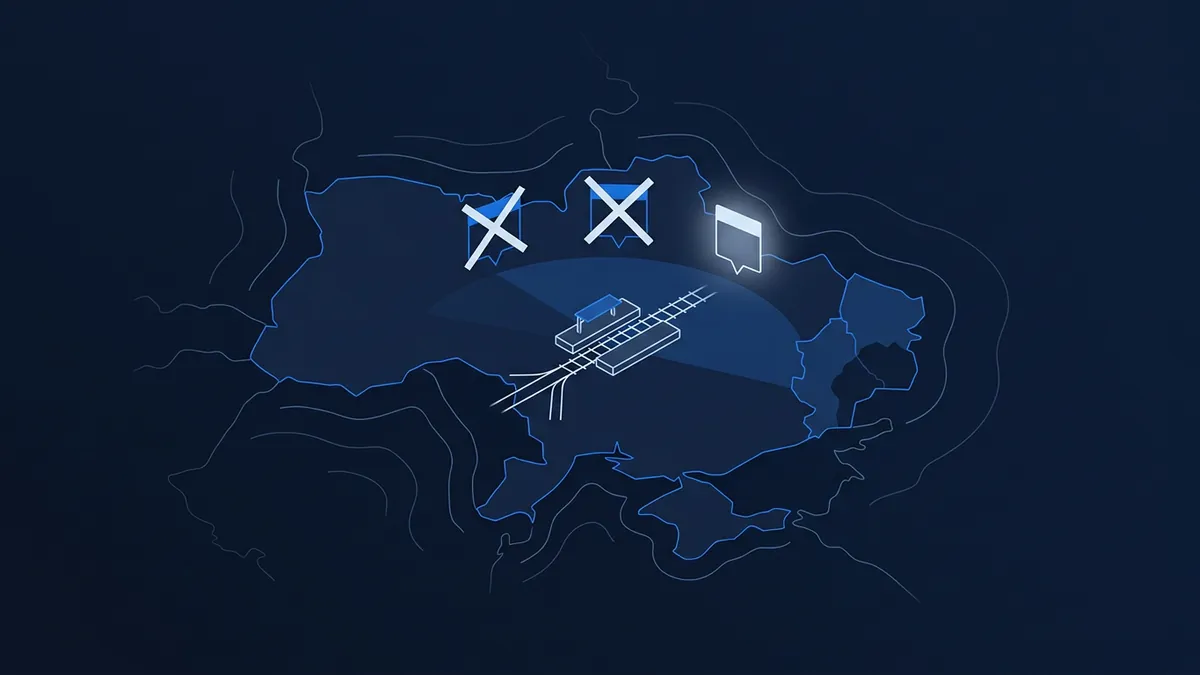
A single train station, somewhere in northeastern Ukraine, has become the resolution criterion for one of Polymarket's longer-running geopolitics contracts. Not a city. Not an oblast. A railway station on Pryvokzalna ploscha in Sumy, and whether any part of its icon on the Institute for the Study of War's interactive map gets shaded red by a given deadline.
That is the question the Sumy capture market on Polymarket puts to traders. Two of its three deadlines have already passed without resolving Yes. The September 30 leg is settled No. The December 31 leg is settled No. What remains is the March 31, 2027 question, and as of 21 June 2026 it trades around 12%.
Deposit $20, get $50 to trade
Welcome bonus on the world's largest prediction market.
18+ · New users only · Availability and terms vary by region · Trading involves risk of loss · BeGambleAware.org
What the contract actually measures
There is a particular kind of precision to how this market resolves, and it is worth sitting with. The ISW map is the arbiter. A small icon for the railway station either gets shaded red or it does not. No press release, no claim from either side's defence ministry, no analyst note matters for resolution. The cartographer's pixel does.
This is unusual scaffolding for a question that sounds, on the surface, geopolitically enormous. "Will Russia capture Sumy?" reads like a question about the war's northern axis, about manpower and momentum and morale. The contract narrows it to a single building's depiction on a single map maintained by a single Washington think tank. That narrowing is the feature, not the bug. It gives traders something falsifiable to price.
It also means the market is not pricing whether Russia will encircle Sumy, hold its outskirts, or even occupy most of it. It is pricing whether one specific dot turns red by one specific date. The two are correlated, of course. They are not identical, and a careful reader should keep the gap in mind. For anyone new to how these contracts work, our explainer on how prediction markets decide who wins walks through why the resolution rule does so much of the heavy lifting.
The two settled legs, and what they tell you
Two of the three questions in this market are over. The September 30 deadline came and went without the station icon turning red. So did December 31. Both resolved No. Whatever those deadlines meant to traders who took the Yes side, they are decided fact now.
This matters for how to read the remaining leg. The March 2027 question is not floating in a vacuum, it is the survivor of a sequence in which the earlier, sooner deadlines failed to resolve Yes. That is information. A reader who wants to understand why the surviving question trades where it trades has to take the failed earlier legs as part of the context. The contract has been telling a consistent story across its life: traders did not expect a fall by autumn, did not expect one by year-end, and are pricing the longer March 2027 question in light of those two settled outcomes.
None of which says anything about who is winning the war, which troop concentrations are where, or what either side's intentions are. The market is silent on all of that. It speaks only to the icon, the map, and the date.
Why the structure is the interesting bit
Most of what makes this contract worth a second look is its construction, not its current level. A binary-style question with a hard cartographic trigger and a calendar deadline is one of the cleanest scaffoldings prediction markets offer. There is no ambiguity about resolution. There is no panel of experts. There is no dispute about whether a city has "fallen" in some squishy sense. Either the icon is shaded by 11:59 PM ET on the date, or it is not.
The trade-off is that the market cannot do nuance. A scenario in which Russian forces hold positions on the city's outskirts indefinitely, neither advancing into the rail district nor retreating, resolves No. A scenario in which a negotiated settlement places the railway station under Russian control by the deadline resolves Yes. Both are politically and militarily very different outcomes, and the market collapses them into the same binary. For a longer take on the war's diplomatic trajectory, our piece on the end-2026 Ukraine-Russia peace deal market covers the other contract running in parallel.
That collapse is what gives the market its edge as a forecasting instrument, and it is also what limits what you can read into the price. The number captures one specific question. Not more.
What a reader should take from this
A contract with two failed earlier legs and one survivor sitting at around 12% as of June 2026 is, structurally, a market that has been consistently sceptical of a near-term capture and now prices a longer-dated version of the same question accordingly. Whether that scepticism is well-calibrated is not something a snapshot can tell you. What the snapshot can tell you is what the contract is actually asking: not whether Sumy falls in any general sense, but whether one railway station's icon on one map turns red by one date.
That is a useful kind of question for a prediction market to ask, because it is answerable. It is also a narrow one, and the narrowness should temper the conclusions any reader draws from the price. iPredicta tracks the Sumy contract alongside the broader set of Ukraine-related markets on Polymarket precisely because the gap between a contract's narrow question and the wider story it gets attached to is where most reader confusion lives.

Frequently asked questions
What exactly does the Sumy capture market resolve on?
It resolves Yes if any part of the railway station icon on Pryvokzalna ploscha in Sumy is shaded red on the Institute for the Study of War's interactive map by the resolution date. If the icon is not shaded red by the deadline, it resolves No. A negotiated settlement placing the territory under Russian control also qualifies for Yes.
Why are two of the three deadlines already shown as settled?
The September 30 and December 31 deadlines have passed without the station icon being shaded red on the ISW map, so both legs resolved No. The only remaining live question is the March 31, 2027 deadline, which trades around 12% as of 21 June 2026.