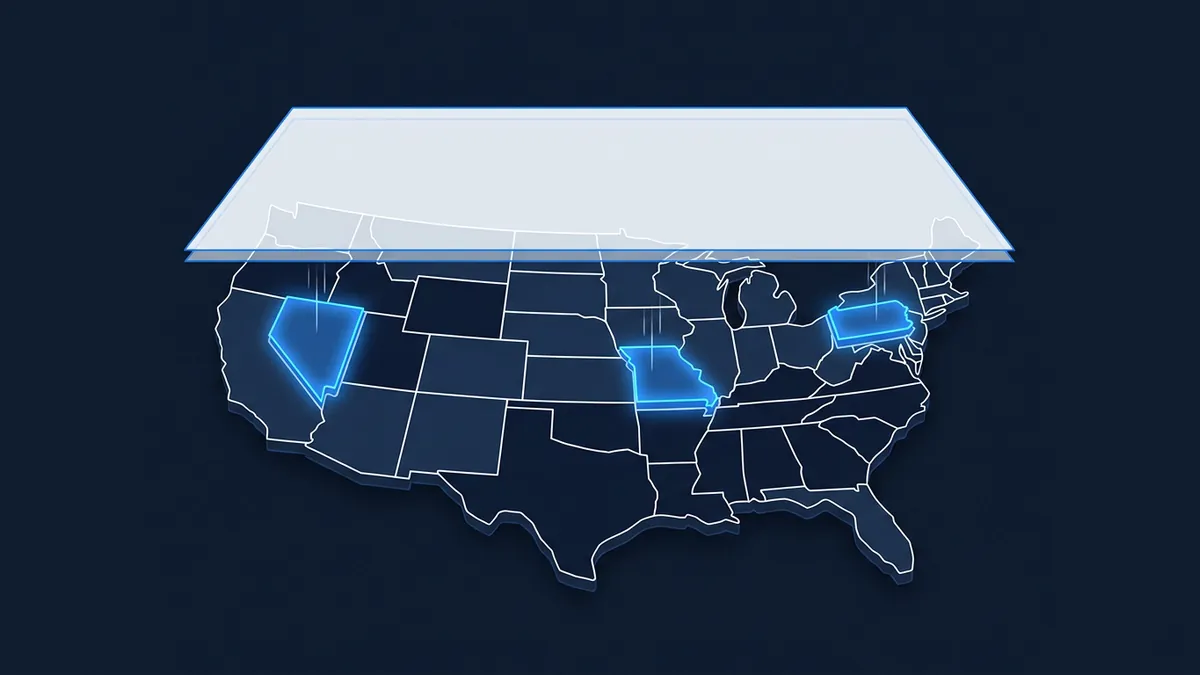
Update, 30 August 2026. The state-by-state position has moved substantially since this was written on 20 June, and it has moved against Kalshi.
Read the headline as the question it is, not as an answer. The page below sets out Kalshi's federal preemption argument and then qualifies it. The qualification is now the more important half, and a reader who takes the title at face value will get the wrong impression. On the current record, Kalshi is not freely available in all fifty states for sports event contracts.
What has changed, as of 30 August 2026:
- Utah. A federal ruling on 6 August 2026 held that Utah's anti-gambling laws can be enforced against prediction-market platforms, and Kalshi was denied the injunction it sought. Reporting at the time described Utah as the eighth state to gain that authority.
- Connecticut. Kalshi's bid for a preliminary injunction was denied in August 2026, with the court declining to treat sports event contracts as swaps. The state has sued to block the contracts and Kalshi has appealed to the Second Circuit.
- Massachusetts. A judge has signalled an order requiring Kalshi to stop taking sports contracts in the state. Pending at the time of writing.
- New Jersey. This one went Kalshi's way. The Third Circuit affirmed the injunction in Kalshi's favour in April 2026, which is the strongest appellate authority the company has.
Kalshi is reported to be in litigation with at least fifteen states and several tribal groups. Nevada, Michigan, Washington and New York have also been reported as securing orders restricting the sports contracts in some form. We have not verified each of those individually and they are named here as reported rather than as established.
The distinction that survives all of this is the one the page already makes, and it is worth stating plainly: the contested category is sports event contracts. The federal preemption argument has fared considerably better on non-sports contracts, and the fights above are almost entirely about sports. Nothing here says the CFTC designation is meaningless. It says the designation has not settled the question in the way the platform's own marketing implies.
This is a fast-moving legal position and it will be out of date again. Treat any specific state's status as needing a check against current reporting before you act on it.
Kalshi's marketing leans hard on five letters: CFTC. The pitch is that because the platform is a Designated Contract Market regulated by the Commodity Futures Trading Commission, it operates under federal financial law, not the patchwork of state gambling statutes that has historically blocked online betting in most of the country. The implication, often left half-said, is that Kalshi is therefore legal everywhere.
The reality is more interesting than that. Federal preemption is a real legal doctrine, and Kalshi has a real CFTC license. But several state regulators disagree with the company's interpretation, cease-and-desist letters have been issued, and the matter is being fought in court rather than settled. For a US reader trying to work out whether they can actually open an account and trade from their living room, the answer depends less on a clean yes-or-no and more on which state they are sitting in, and whether that state has decided to pick a fight.
Deposit $20, get $50 to trade
Welcome bonus on the world's largest prediction market.
18+ · New users only · Availability and terms vary by region · Trading involves risk of loss · BeGambleAware.org
The federal claim, in one paragraph
Kalshi is registered with the CFTC as a Designated Contract Market, the same regulatory category that covers the Chicago Mercantile Exchange and other US futures venues. Its products are styled as event contracts, which are a flavour of derivative. The company's legal argument is that derivatives regulated under the Commodity Exchange Act fall under exclusive federal jurisdiction, which means state gambling commissions do not get a say in what Kalshi offers or who it offers it to. If you accept that argument, Kalshi is legal in all 50 states by default. If you do not, the picture gets messier fast. Our explainer on what an event contract actually is walks through the legal category in more depth.
Why state regulators do not buy it
The pushback started in earnest when Kalshi began listing sports event contracts. To a state gaming commissioner, a contract that pays out based on who wins the Super Bowl looks like a sports bet wearing a futures-contract costume. New Jersey, Nevada, Montana, and several other states have sent cease-and-desist letters arguing that the sports markets, in particular, fall under state gambling jurisdiction regardless of how the contract is labelled at the federal level. Their position is roughly: if it walks like a bet and pays like a bet, the fact that it clears through a CFTC venue does not exempt it from state law.
Kalshi has responded by going to court. The company has sued state regulators in multiple jurisdictions, asking federal judges to confirm that the Commodity Exchange Act preempts state action. Some early rulings have gone Kalshi's way on preemption grounds in one circuit, with mixed outcomes elsewhere; none of them have produced a clean, nationwide precedent that closes the question. The fight is live, and that matters for anyone trying to read the legal map today.
What "available" actually means in practice
There is a difference between what is theoretically legal and what you can actually do from your sofa. Kalshi's app uses geolocation. In most states, you can sign up, fund an account, and trade. In a small number of states, the company has either voluntarily geofenced certain product categories (most commonly sports contracts) or pulled access entirely while the legal fight plays out. The list of restricted states has changed more than once and will probably change again. As a rough rule of thumb, the states most likely to be on the friction list are the ones with the most developed regulated sports-betting industries, because their gaming commissions have the most institutional reason to defend their turf.
For the practical mechanics of signing up, our guide on how to open a Kalshi account covers the verification flow and what to expect at the geolocation check.
The states most likely to push back
Four states are worth flagging as the recurring friction points: New Jersey, Nevada, Montana, and a rotating cast of others that have either sent letters or signalled they might. Why these? New Jersey is the regulatory home of the modern US sports-betting industry and treats encroachment seriously. Nevada has the oldest and most jealously guarded gambling regime in the country. Montana has an unusual statutory structure that gives the state lottery monopoly power over sports-related contracts. The pattern is consistent: states with strong existing gambling frameworks see Kalshi's sports markets as a direct competitor that has skipped their licensing process, and they respond accordingly.
This does not mean Kalshi is unavailable in those states for all product categories. Election markets, economic markets, and weather contracts have generally drawn less state-level attention than sports. The fight has concentrated on sports because that is where state regulators feel the encroachment most sharply.
How this compares to Polymarket
Kalshi's situation is genuinely different from Polymarket's, and conflating the two is a common mistake. Polymarket is offshore, runs on a public blockchain, and historically did not serve US users at all after a 2022 CFTC settlement; access for American traders has only recently been re-established through a regulated entry point, which our piece on Polymarket's regulated US access covers in detail. Kalshi, by contrast, has been onshore and CFTC-regulated from the start, which is why its legal posture is fundamentally about federal-versus-state authority rather than about whether to enter the US market at all.
If you want a side-by-side on the two platforms more broadly, our Polymarket vs Kalshi comparison walks through fees, liquidity, and product range.
The direction of travel
Where does this end? Honest answer: nobody knows. There are three plausible paths. One is that a federal appeals court hands Kalshi a clean preemption win, the state pushback collapses, and Kalshi operates everywhere without friction. The second is that a court rules the other way on sports contracts specifically, forcing Kalshi to either pull sports nationwide or license state by state. The third, and probably the most likely in the near term, is a continued patchwork: legal in most states, restricted in some, with the line moving as individual cases resolve.
For a wider view of the federal legal posture, our explainer on whether prediction markets are legal in the US sets out the broader framework.

The practical takeaway
If you are sitting in a US state and want to know whether you can use Kalshi, the answer is almost certainly yes for most product categories, possibly no for sports contracts depending on where you live, and subject to change as the litigation moves. The CFTC license is real and meaningful; it gives Kalshi a much stronger legal footing than any offshore or unregulated venue. But "federally regulated" does not automatically translate to "untouchable by state law," and the marketing sometimes blurs that distinction. The honest version is that Kalshi is the most accessible regulated prediction market for US users, with a small but non-zero number of state-level asterisks attached.
iPredicta tracks prediction market activity across Kalshi, Polymarket, and the regulated UK venues, and the state-level access situation in the US is part of what we cover when readers ask where a contract is actually tradable. The legal map keeps moving, and the platforms that are easiest to use today are not always the ones that will be easiest to use a year from now.
Frequently asked questions
Is Kalshi legal in all 50 US states?
Kalshi's position is that yes, it is legal in all 50 states because it operates as a CFTC-regulated Designated Contract Market and federal derivatives law preempts state gambling statutes. Several state regulators disagree, and the disagreement is being fought out in federal court rather than settled. In practice, Kalshi is accessible to users in most states for most product categories, but certain product types (especially sports contracts) are geofenced or restricted in a small number of states where regulators have pushed back hardest. The legal answer and the practical answer are not quite the same, and both are subject to change as the litigation resolves.
Which states have tried to block Kalshi?
New Jersey, Nevada, and Montana have been among the most active state regulators in pushing back, with cease-and-desist letters focused primarily on Kalshi's sports event contracts. Other states have signalled concern at various points without taking formal action. The pattern is consistent: states with mature, heavily regulated sports-betting industries are the ones most likely to view Kalshi's sports markets as encroachment on their licensing authority. Election, economic, and weather contracts have drawn much less state-level scrutiny because they do not compete with established state-licensed sportsbooks. The list of friction states changes as cases progress, so it is worth checking Kalshi's own state availability page before assuming access.
Does CFTC regulation actually preempt state gambling law?
That is the legal question at the heart of the fight, and it has not been definitively answered. Kalshi's argument relies on the Commodity Exchange Act, which gives the CFTC exclusive jurisdiction over derivatives traded on Designated Contract Markets. State regulators counter that gambling regulation is a traditional state police power that Congress did not intend to override when it set up the futures regime. Some early court rulings have gone in Kalshi's favour on preemption grounds, but no appeals-court decision has yet produced a clean nationwide precedent. Until one does, the question of whether CFTC oversight truly trumps state gambling law in this context remains genuinely open.
Can I trade Kalshi sports contracts everywhere?
No, sports contracts are the most geographically restricted product category on Kalshi. They are the product type that has drawn the sharpest state regulatory pushback, and Kalshi has either voluntarily geofenced or been ordered to restrict them in certain states while litigation proceeds. The exact list of restricted states has shifted multiple times and is the part of Kalshi's access map most likely to change in the near future. Other product categories, including election markets, economic data contracts, and weather markets, are generally available more broadly because they have not attracted the same level of state-regulator attention from gaming commissions defending sports-betting jurisdiction.
How is Kalshi's legal situation different from Polymarket's?
Kalshi is a US-domiciled, CFTC-regulated venue fighting state regulators over jurisdiction; Polymarket is an offshore platform that was blocked from serving US users entirely after a 2022 CFTC settlement and has only recently reopened American access through a separate regulated entry point. The two platforms face fundamentally different legal questions. Kalshi's fight is about whether federal financial regulation overrides state gambling law for an onshore, licensed venue. Polymarket's situation was about whether an unlicensed offshore venue could serve US users at all. Conflating the two leads to confusion. Our Polymarket vs Kalshi comparison and the Polymarket US access explainer cover the distinction in more depth.