If you are in the US and choosing between Polymarket and Kalshi in mid-2026, both are now things you can actually sign up to and trade on. Kalshi is open, regulated, and serving around 44 states. Polymarket US dropped its waitlist in May 2026 and opened general signup, iOS-only (Android and web still pending) and 18+, though it is still sports-led while other categories roll out. Both sit on top of the US prediction-markets industry, both are valued in the billions, both are federally approved. The choice now turns on breadth, fees, and maturity rather than on who will let you in.
That is the headline answer. The longer answer is more interesting because the two platforms have taken fundamentally different routes to the same destination, and the consequences of those routes show up in fees, liquidity, regulation, UX, and which markets you can actually trade. Kalshi has operated inside the US regulatory perimeter since day one and has long held roughly 90% of the US prediction-markets market share by volume, a lead Polymarket US only began to contest after its May 2026 launch. Polymarket built its $33 billion-plus in 2025 global volume on crypto rails from an offshore base, then paid $112 million to buy a CFTC-licensed exchange and re-enter the US. The Kalshi you sign up to is the same product US users have been using since 2021. The Polymarket you would sign up to in the US is a new, restricted product, not the same thing as the Polymarket your friends in Europe might have used.
For UK users, the answer is simpler and more disappointing. Neither platform is available to you. Both geoblock the UK for regulatory reasons we covered in our guide to whether prediction markets are legal in the UK. What follows is a comparison written for anyone trying to understand the two platforms, whether you are a US user choosing where to trade, a UK user assessing them from a distance, or simply trying to make sense of two companies that regularly feature in the financial press.
This is an educational guide, not financial or legal advice. Numbers below are accurate as of mid-2026 but prediction-market companies move fast, always check a platform's own current terms before sending real money.
Deposit $20, get $50 to trade
Welcome bonus on the world's largest prediction market.
18+ · New users only · Availability and terms vary by region · Trading involves risk of loss · BeGambleAware.org
The short answer
For US traders who want access today: Kalshi. You can sign up, fund with a bank account, and trade within the hour. Coverage includes sports, politics, economics, crypto, climate, and mention markets. Commission structure is per-contract and tiered, expect fees of around $0.02 to $0.04 per contract on most trades, capped at $1.75 per 100 contracts for takers.
For US traders who want Polymarket specifically: signup is now open. Polymarket US dropped its waitlist in May 2026 (iOS first, with Android still rolling out) and onboards eligible US users at 18+, though it still offers sports markets only while other categories roll out. Its fees use the same formula as Kalshi with a lower coefficient, 0.06 against 0.07, so it peaks at 1.50¢ per contract against Kalshi's 1.75¢. As more categories arrive, the calculus shifts further in its favour for fee-sensitive traders.
For UK traders: both are view-only. Polymarket lets you browse markets, Kalshi blocks the UK at sign-up. Betfair Exchange is the closest UK-legal equivalent for political markets.
Kalshi vs Polymarket at a glance
| Kalshi | Polymarket (US) | Polymarket (offshore) | |
|---|---|---|---|
| Who can use it | US, ~44 states, 18+ | US, iOS app only, 40+ states, 18+ (Android/web pending) | Outside US; geoblocks US and UK |
| Regulation | CFTC-regulated since 2021 | CFTC-regulated via the QCEX licence Polymarket bought for $112M | Offshore, crypto rails, no US/UK licence |
| Funding | Bank account (USD) | USD | Crypto (USDC) |
| Fees | 0.07 x contracts x price x (1 - price), at most 1.75c per contract | 0.06, so at most 1.50c per contract, all categories | 0.04 on politics, at most 1.00c per contract; crypto 0.07, geopolitics free |
| Market breadth | Broad: politics, economics, sports, crypto, climate, mention markets | Narrower, sports-led, categories rolling out | Broadest: the original deep global board |
| Liquidity | Deep on headline US markets | Building | Deepest overall ($33B+ traded in 2025) |
| Best for | US users wanting regulated access today across categories | US users who specifically want the Polymarket brand on a regulated rail | Non-US users wanting the deepest, broadest board |
UK users: neither is available. Both geoblock the UK (why).
Access and availability
Kalshi
Kalshi operates as a CFTC-regulated designated contract market and is available in around 44 states as of mid-2026. The platform handles identity verification and funding through traditional banking rails, ACH, debit card, wire transfer, Apple Pay, and crypto deposits that convert to USD on arrival. Account opening takes minutes rather than days, which is a quiet but meaningful advantage. You do not need a crypto wallet, you do not need to understand gas fees, and your balance is denominated in dollars.
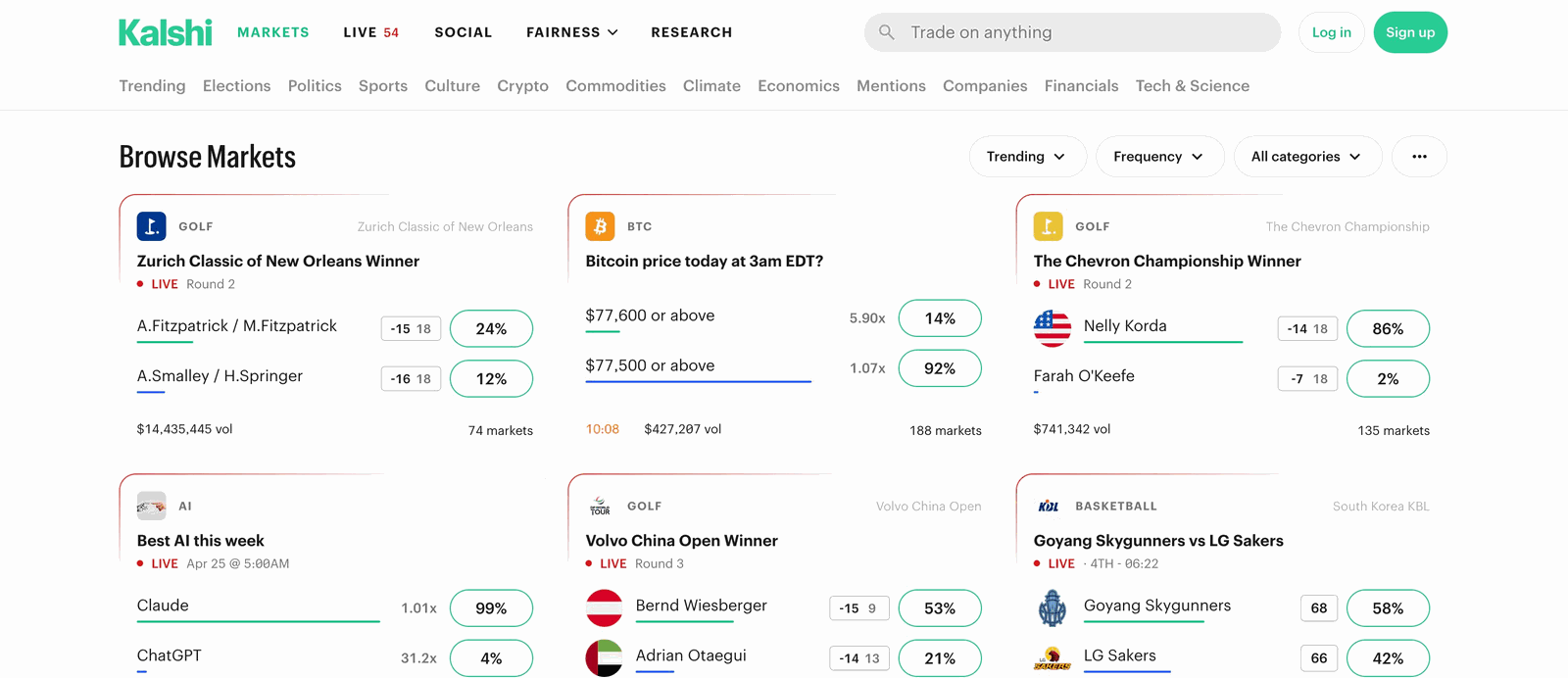
The exclusions matter. State-level pushback against Kalshi has been significant in 2025 and 2026. Nevada obtained a temporary restraining order in March 2026 prohibiting Kalshi from offering sports, election and entertainment contracts to anyone in the state, and that became a preliminary injunction in April which remains in force while Kalshi appeals. Massachusetts, Tennessee, Ohio, and Arizona have all mounted enforcement actions. The results have been mixed, Kalshi won preliminary injunctions in Tennessee and New Jersey, lost in Ohio and Nevada, and the Massachusetts case is heading for appeal. The federal preemption question underlying these cases is widely expected to reach the Supreme Court in 2026 or 2027. By mid-2026 the picture had widened well beyond these states: roughly a dozen states had enforcement actions or litigation in progress, Minnesota passed the first outright ban, due to take effect 1 August 2026, which a federal judge enjoined on 27 July days before it landed, so it has never been in force and both platforms continue to operate there while the case proceeds, and the CFTC began counter-suing states in federal court.
For most US users in most states, none of this affects day-to-day access. The platform works. The litigation matters primarily for traders in states where Kalshi is currently excluded or at risk of exclusion. For the full state-by-state breakdown, see our guide to whether prediction markets are legal in the US.
Polymarket US
Polymarket's US product is a different animal from its offshore platform. In July 2025 the company acquired QCEX, a CFTC-licensed derivatives exchange, for $112 million. The CFTC issued an Amended Order of Designation in November 2025, Polymarket relaunched in the US in December 2025 through an invite-only waitlist, and in May 2026 it dropped the waitlist and opened general US signup, iOS first, with the Android app still rolling out. Onboarding is open to eligible US residents at 18+, though the product is still sports-led while other categories expand. For the mechanics of how this regulated, intermediated access works, see our guide to how Polymarket's regulated US access works after the QCEX deal.
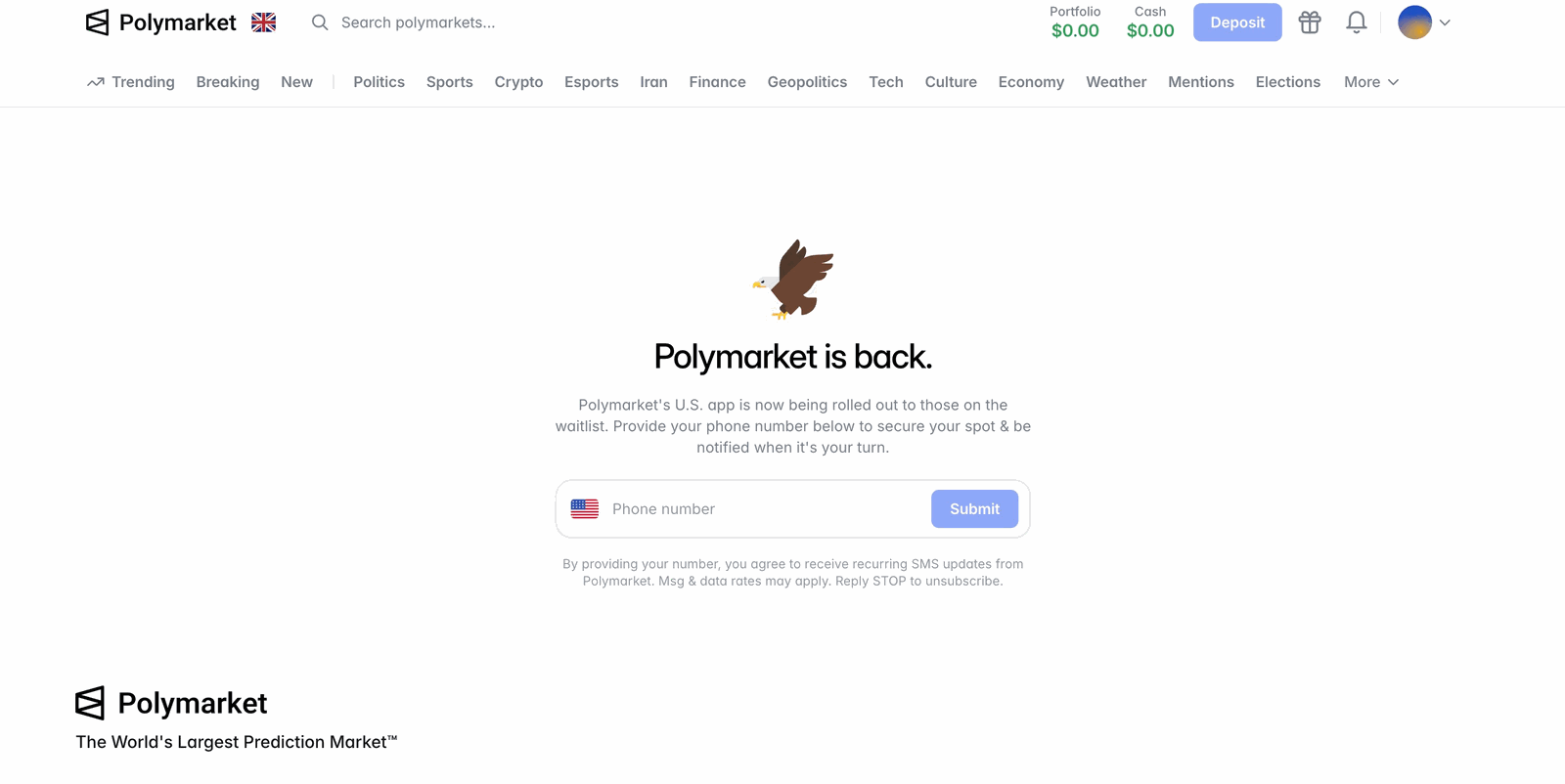
The waitlist is gone: eligible US users can now register directly on iOS, with the Android app still rolling out. The product itself is functional but limited. Sports markets on the major US leagues, a 0.06 coefficient on every category, wallet-based funding via USDC or similar stablecoins. If you want elections, economics, crypto contracts, or global events, you are still waiting for a category rollout that has no firm public timeline.
Polymarket offshore (the original)
The main Polymarket brand, the one that processed $33.4 billion in 2025 volume and became a fixture of the 2024 US election news cycle, is a separate product. It operates on the Polygon blockchain using USDC, runs 350,000-plus active markets across every category, and is available internationally with the usual set of restricted jurisdictions (US, UK, Germany, France, Italy, Netherlands, Belgium, and about 40 others). For most readers of this article, offshore Polymarket is interesting context but not a platform you can use, if you are in a restricted country, attempting to access it violates the Terms of Use and will get your account terminated.
Fees and costs
The two platforms have fundamentally different fee structures and neither is universally cheaper, it depends on what you trade.
Kalshi's fee formula is: 0.07 × contracts × price × (1 − price), capped at $1.75 per 100 contracts for takers and $0.44 for makers. Because price appears as p × (1−p) in the formula, fees peak on contracts priced near 50¢ and drop sharply on contracts priced near the extremes. A 90¢/10¢ contract costs almost nothing to trade. A 50¢/50¢ contract is at the fee peak.
Polymarket US uses the same shape of formula as Kalshi, with a coefficient of 0.06 instead of 0.07 and no category exemptions, effective 1 July 2026. So it peaks at 1.50¢ per contract against Kalshi's 1.75¢, both at 50¢, and both fall away towards the extremes. Polymarket US is cheaper, but by about a seventh rather than by an order of magnitude, and makers there are paid 0.0125 at the point of trade rather than charged. For very active traders the cumulative savings matter. For casual users placing a few trades a month, the difference is immaterial.
A more important point: Kalshi has no deposit or withdrawal fees. Polymarket US uses crypto rails, which means gas fees on the underlying blockchain for wallet operations. These are typically small but non-zero and they add up. Kalshi is the simpler cost structure to reason about.
Liquidity and market depth
Kalshi has deeper liquidity in sports and macro markets, which together account for around 90% of its volume. The order books in its headline NFL, NBA, and economics markets regularly absorb institutional-sized orders without meaningful slippage. Spreads are tight. For traders placing $1,000 to $50,000 at a time in major markets, Kalshi is the more reliable execution venue today, simply because it has had three more years of operation and a larger active user base.
Polymarket offshore remains the deepest market globally for politics and long-tail events, the 2024 election drove weekly volumes above $2 billion for multiple consecutive weeks, and the category mix is genuinely distributed (around 60% of volume comes from outside sports). But that liquidity does not transfer to Polymarket US, which is a separate product with a separate user base. Polymarket US is in beta. Its liquidity is shallow and concentrated in a handful of sports markets.
The takeaway: if you want deep liquidity in the US today, Kalshi. If you want deep liquidity in politics or global events, Polymarket offshore, which you cannot legally access from the US, UK, or most European markets.
Markets and categories
Kalshi's market coverage is broader than Polymarket US's by a wide margin. Sports, politics, economics, crypto, climate, entertainment, and mention markets are all live. The mention markets are particularly distinctive, contracts on whether specific words or phrases will appear in speeches, press conferences, or Federal Reserve statements. Kalshi launched these in late 2025 and they have grown to volumes comparable to smaller sporting events.
Polymarket US is currently sports-only. This is a regulatory and operational choice, the full product is designed to offer the same breadth as the offshore version, but roll-out is staged. Expect categories to expand through 2026 but treat specific timelines with scepticism until the company announces them.
For anyone whose interest is political markets specifically, the honest answer for US users is that Kalshi is your option until Polymarket US expands. For UK users, Betfair Exchange has run political markets since 2000 and remains the deepest UK-legal venue for UK and US political contracts, though the UX is noticeably more dated than either Kalshi or Polymarket. For background on how prediction markets work as a category, see our guide to what prediction markets are.
Regulation and trust
Both platforms are now federally regulated in the US under the CFTC. The difference is how long they have been there and how contested that regulation is.
Kalshi has been CFTC-designated since 2020 and has the longer track record. Its institutional backing, Sequoia, Paradigm, Charles Schwab among the Series E investors at an $11 billion valuation, reflects that maturity. The live regulatory risk for Kalshi is state-level: the series of state gambling-law challenges that will ultimately reach the Supreme Court. A ruling against federal preemption would force Kalshi to license state-by-state with individual gaming commissions, which would materially change its cost structure and state coverage.
Polymarket US is newer to CFTC regulation, approved November 2025, operational January 2026. The platform inherits the QCEX CFTC licence it acquired rather than building from scratch. Its offshore parent continues to operate with a separate legal and regulatory identity. Polymarket's main strategic risk is different from Kalshi's: the planned crypto token launch. The token introduces both a growth lever (airdrops incentivise user activity) and a complication (regulators scrutinise whether activity is organic or incentivised). How the SEC and CFTC treat the token when it launches will matter for the company's long-term trajectory.
What this means in practice
If you are a US user who wants to trade prediction markets today, Kalshi is the obvious answer. It works, it is regulated, it has the markets and the liquidity, and your account will be up and funded the same day. Polymarket US is for users who specifically want its product and fee structure, can operate comfortably with crypto wallets, and are comfortable with a still-narrow, sports-led category set. Both are credible businesses. One is available to you, the other is aspirational.
If you are a UK user, neither is currently available for trading. Betfair Exchange is the practical alternative for political markets. Smarkets is the commission-friendly alternative for smaller positions. Matchbook's announced 2026 UK prediction-markets platform is the one to watch.
If you are simply trying to understand the space: Kalshi is the boring, compliant, traditional-finance-looking product. Polymarket is the crypto-native, permissionless-feeling product that has taken a more circuitous route to US compliance. Both will probably matter for years. Whether one takes the whole market or they split it is the commercial question investors are pricing right now, and the recent divergence in their valuations, Kalshi $11B, Polymarket reportedly valued around $7B less, suggests the market is tilting toward Kalshi on near-term execution but leaving room for Polymarket to close the gap if the US rollout delivers.

How iPredicta fits in
iPredicta is a prediction-markets discovery and intelligence platform. We aggregate Polymarket, Kalshi, and other venues so you can see the best available price across platforms on any given contract, flag arbitrage opportunities when they appear, and understand which platforms you can actually use from your jurisdiction. When Polymarket US rolls out more widely or Kalshi's state coverage changes, we will reflect that live. Our job is to help you act on the information, not to sell you one platform over another.
Frequently asked questions
Is Kalshi better than Polymarket?
For US users in mid-2026, Kalshi is still the broader choice, it is open, regulated, available in around 44 states, covers many categories, and you can sign up and trade the same day. Polymarket US dropped its waitlist in May 2026 and is now open to US signup (iOS-only for now, 18+) but remains sports-only for now. Its 0.06 coefficient is modestly lower than Kalshi's 0.07, peaking at 1.50¢ per contract against 1.75¢. "Better" depends on whether you value category breadth today or the cheaper fee structure on sports.
Can I use both Kalshi and Polymarket?
Yes. The two platforms have separate accounts, separate funding, and different market coverage, so it is common for active traders to maintain accounts on both and route orders to whichever has the better price or deeper book on a given contract. Note that Polymarket US signup is now open (iOS-only for now, 18+) after the May 2026 waitlist removal, while the offshore Polymarket platform that operates internationally is not legally accessible to US, UK, or most European residents, using a VPN to access it violates the Terms of Use and will get your account terminated.
Is Polymarket available in the US?
Yes. Polymarket acquired QCEX, a CFTC-licensed exchange, for $112 million in July 2025, received its Amended Order of Designation from the CFTC in November 2025, and relaunched in the US in December 2025 behind an invite waitlist. In May 2026 it dropped the waitlist and opened general US signup, iOS first, with Android still rolling out; onboarding is open to eligible US residents at 18+, though the product is still sports-only while other categories roll out. Polymarket US is a separate product from the offshore Polymarket platform that powered the 2024 election cycle.
Can UK users access Polymarket or Kalshi?
No. Both platforms geoblock UK users at the trading level. Polymarket lets you browse markets in view-only mode but blocks signup and deposit; Kalshi blocks signup outright with a notice listing the United Kingdom on its prohibited-countries page. The regulatory reason is the FCA's 2019 ban on binary options to retail consumers. UK users wanting similar products can use Betfair Exchange or Smarkets, both UKGC-licensed betting exchanges with mechanically similar order books.
What are the fees on Polymarket vs Kalshi?
Kalshi's fee formula is 0.07 × contracts × price × (1 − price), capped at $1.75 per 100 contracts for takers and $0.44 for makers. Fees peak on contracts priced near 50¢ and drop sharply near the extremes. Polymarket US uses the same formula with a 0.06 coefficient, so it peaks at 1.50¢ per contract against Kalshi's 1.75¢. Offshore Polymarket charges 0.04 on politics, at most 1.00¢, and nothing at all on geopolitics and world events. Both platforms have no deposit or withdrawal fees, though Polymarket uses crypto rails so blockchain gas fees apply on wallet operations.
Is Kalshi or Polymarket better?
There is no single winner; it depends on where you are and what you want to trade. For a US user who wants regulated access today across the widest range of categories, Kalshi is the simpler answer: open in around 44 states, fund from a bank account, trading within the hour. For a US user who specifically wants Polymarket, its US app is now open on iOS after the company bought a CFTC-licensed exchange, though it is still sports-led while other markets roll out. For the deepest, broadest board, the original offshore Polymarket is unmatched, but it geoblocks US and UK users. For UK users, neither is available. So the honest answer: Kalshi for breadth of access in the US right now, offshore Polymarket for depth, and the "best" one is whichever is actually open to you.