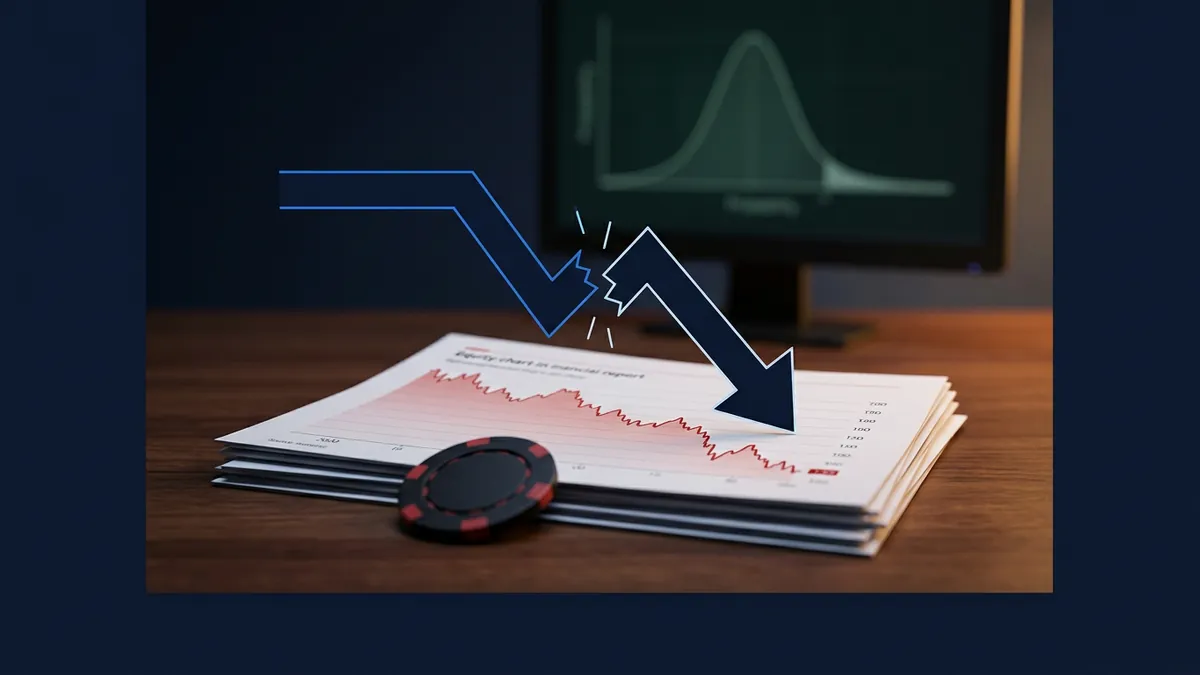
S3 Partners published a number this week that gives the prediction-markets-versus-bookmakers debate an unfamiliar feature: a hard dollar figure attached to one side of it. Hedge funds running short positions on the major listed gambling operators are sitting on $2.3 billion of paper profits for 2026, according to data reported by the Irish Times. The Financial Times broke the story and the Irish Times carries the same content; the underlying disclosures are public FCA filings and S3's aggregation.
The trajectory is steeper for some operators than others. Flutter Entertainment, owner of Paddy Power, FanDuel, and Sky Bet, is down roughly 50 per cent year to date, and the short positions against it account for $2 billion of the headline number on its own. DraftKings shorts have cleared $351 million, with the stock down about 30 per cent. Entain, the Ladbrokes and Coral parent, has produced $35 million in shorting gains and a similar 30 per cent drawdown. The exception is Evoke, the William Hill and 888 owner, where shorts have actually lost $3.5 million after the stock rebounded roughly 50 per cent from December lows on Bally's takeover talks. Consolidation, in that one case, has rewarded the longs.
The names on the disclosures are the ones you would expect. Two Sigma holds the largest single position at 2.17 per cent of Flutter. DE Shaw shows 1.49 per cent. AQR Capital Management, Marshall Wace, Balyasny Asset Management, Millennium International Management, and Capital Fund Management each appear in the FCA filings at varying scale. Marshall Wace's Entain short reached as high as 1.7 per cent in April before being partly closed. None of the firms has commented. None of them needs to.
Deposit $20, get $50 to trade
Welcome bonus on the world's largest prediction market.
18+ · New users only · Availability and terms vary by region · Trading involves risk of loss · BeGambleAware.org
The bear case is more credible than the structural-disruption camp tends to admit
Beyond the partisan framings on either side, there is a genuine question about whether the institutions shorting these stocks have correctly priced the risk, or whether Barclays analyst Brandt Montour is right that the market has reached "extreme levels of pessimism" and that a relief rally is overdue. The analytical move is to take Montour's position seriously rather than to dismiss it.
Start with the regulatory file. The "Prediction Markets Are Gambling Act", introduced in March by Senators Curtis and Schiff, would treat sports event contracts as gambling for federal purposes and route them through state regulators rather than the CFTC. The CFTC closed its own public comment period on prediction market rulemaking on 30 April. State attorneys general in Illinois, Connecticut and elsewhere have issued cease-and-desist letters to Kalshi, Polymarket, Crypto.com and Robinhood over sports markets. The SEC is separately examining prediction market ETFs. Each of these processes can be reported, but none of them can be predicted, and the honest answer is that they sit on a probability distribution rather than a yes-or-no outcome. What can be said is that the sports concentration on these venues is material. Kalshi reports that sports represents 87 per cent of its $39.7 billion in annual volume; Polymarket says 38 per cent of its $36.2 billion. A US-wide constraint on sports would not finish prediction markets, but it would shift their economic centre of gravity. The framing matters too, since the regulatory term of art is the event contract rather than the prediction market, and the eventual rulemaking will turn partly on which label sticks.
The second area where the bears have a real point is the soft underbelly of how prediction markets clear. Insider trading is harder to police than in equities. The asymmetric-information cases that exchanges build entire compliance functions to detect are structurally easier to execute on a venue where contracts settle on real-world events that participants may know about before they are public. The legal-disputes landscape compounds this. An operator running into adverse rulings on consumer protection, on advertising, or on customer-segregation requirements may end up burning the operating cushion that the structural-disruption story assumes.
Then there are the bookmakers' own problems, which the prediction-markets narrative has a tendency to take credit for. Entain disclosed an unexpected £488 million impairment charge in March, driven specifically by United Kingdom tax rises following Rachel Reeves's November Budget, which raised online gambling and casino duties. Flutter warned in February about the same United Kingdom tax trajectory. Citi downgraded Flutter from buy to sell last month on those mechanics rather than on prediction-markets share theft. If you remove prediction markets from the explanation, you still get a substantial bookmaker drawdown, and the analyst question is how much of the share-price story belongs to which driver. The same question sits underneath the broader comparison between prediction markets and traditional sports betting, which is rarely as clean a substitution story as the headlines suggest.
Polymarket itself runs a market on the central regulatory question, Law banning sports prediction markets enacted in 2026. It is also, at roughly $14,000 of total volume and under $10 in the last 24 hours, too thin to read prices off with any confidence. The market exists, which is a data point about what traders consider worth pricing at all, but the order book is not deep enough for the level to function as a forecast. The bears are correct that nobody is paying serious money to handicap this question yet. They may also be correct that the silence reflects how genuinely uncertain the regulatory path is.
Where the bears appear to be less right is on institutional positioning. The interesting feature of the FCA disclosures is not just that the shorts are at headline levels, but that they have not been closed. Marshall Wace has trimmed Entain, but the Two Sigma, DE Shaw and AQR positions on Flutter remain at scale despite five months of regulatory news, despite Montour's relief-rally call, and despite the Evoke counter-example demonstrating what these funds look like when they cover early. If the consensus inside these funds were that the bookmaker decline is mostly United Kingdom tax and that prediction markets will be successfully constrained, the rational trade would be to lighten up. They have not, in aggregate. That is not proof of a thesis. It is a statement of where institutional money sits while the regulatory questions resolve. The structural-disruption camp does not get to claim victory from this, and the bears do not get to claim it either. What it does suggest is that smart-money positioning takes the regulatory-uncertainty argument seriously and still concludes the listed bookmakers face a problem the relief-rally trade cannot solve on its own. Whether that problem is named prediction markets or named secular pressure on the online-gambling product, the short trade has continued to print.

Frequently asked questions
What can large short positions tell us about a stock's future?
Short positions are bets, not forecasts. A fund holding 2 per cent of a company short has expressed a view about the next several months and is paying a borrowing cost to express it. That view is informed, and at the scale of Two Sigma or DE Shaw it is informed by analytical resources that retail investors cannot match. But it is still positioning rather than prophecy. The most useful signal from large coordinated short positions is not the direction itself, which is obvious from the disclosures, but the duration. When sophisticated funds maintain positions through bad news and ride out an analyst relief-rally call without closing, they are saying something about their conviction. When they cover into the first sign of a turn, as Marshall Wace appears to have done partially on Entain, they are saying something about its limits.
Will US regulators ban sports prediction markets?
The honest answer is that the probability distribution sits across several plausible outcomes and that none of them is yet the consensus. The Curtis-Schiff bill in the Senate, the CFTC rulemaking process, the state cease-and-desist letters, and the SEC ETF inquiry all run on different timetables and different theories of the case. A federal ban specifically targeting sports event contracts is on the table. A more permissive CFTC framework, perhaps with sports excluded, is also on the table. Outcomes where the venues operate freely in some states and not others are increasingly likely, and the broader picture on whether prediction markets are legal in the US is unusually jurisdiction-sensitive right now. The Polymarket market that asks the ban question directly has too little volume to function as a forecast yet, which is itself a useful data point. Watching where state-level enforcement lands first, and how the CFTC responds to its rulemaking comments, is more informative than waiting for a single decisive ruling.