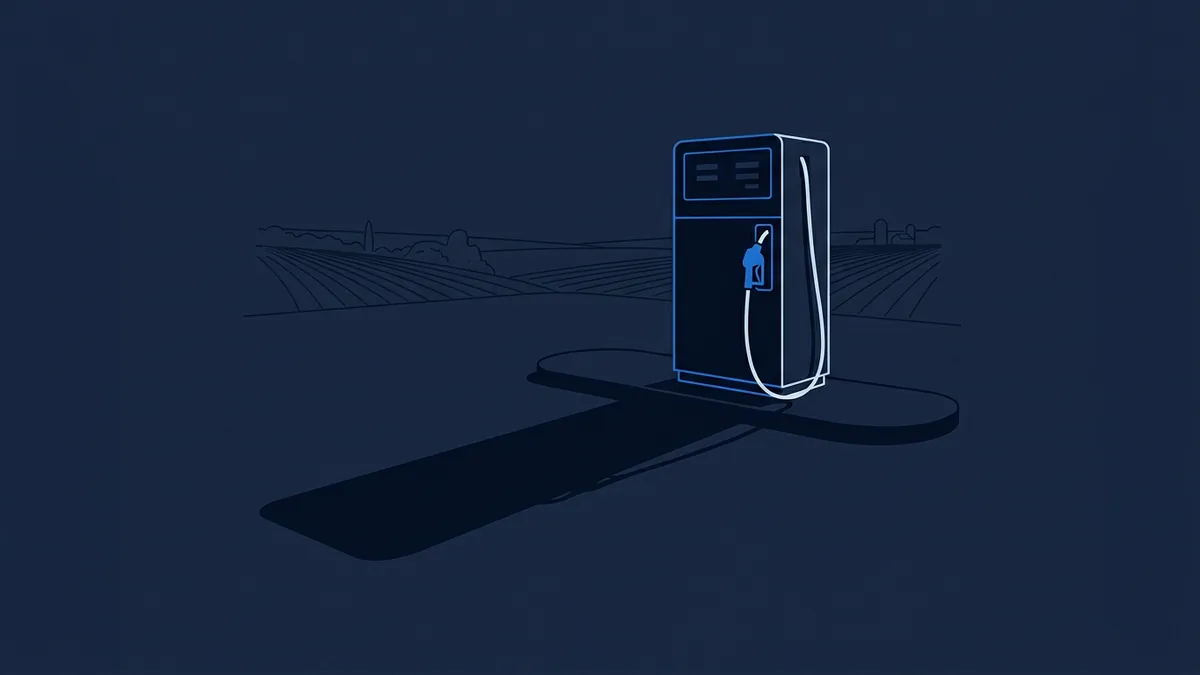
A diesel pump in a village in mid-Wales is not where most people expect a war story to land. But that is roughly the picture the Guardian painted on 3 June, relaying an OECD forecast that singles out rural Britain as the geography most exposed if the Iran conflict keeps squeezing fuel supply chains into 2027. Farms, hauliers, off-grid heating households. The places where diesel is not optional.
The headline number is almost reassuring. The OECD nudged UK growth for the year up to 0.9%, from a March estimate of 0.7%, crediting government spending for the short-term cushion. Underneath that, though, sits a much less comforting forecast: a wave of recessions across advanced economies if the war drags into 2027, and a UK fuel network whose weakest link is a B-road in Powys.
Deposit $20, get $50 to trade
Welcome bonus on the world's largest prediction market.
18+ · New users only · Availability and terms vary by region · Trading involves risk of loss · BeGambleAware.org
Why diesel, and why rural
The OECD's warning is mechanical rather than political. Iran sits on the Strait of Hormuz, and a meaningful share of global diesel and the crude feedstock that becomes diesel flows through that water. Squeeze the strait, or squeeze Iranian export volumes, and middle-distillate prices move first and fastest. Petrol gets the headlines. Diesel does the work.
In the UK, that distinction matters more than it does in countries with denser rail freight and shorter haulage runs. Almost everything heavy that moves on a British road moves on diesel. So does most agricultural machinery, a chunk of off-grid heating in the form of red diesel and heating oil, and the resupply trucks that keep rural forecourts stocked in the first place. When wholesale tightness hits, the marginal forecourt that loses its delivery slot tends to be the one furthest from the depot.
That is what the OECD is flagging. Not a national shortage in the 1970s sense, but a patchy, postcode-lottery tightness where a farmer outside Brecon waits three days for a tank refill that a London bus depot gets the same afternoon. The macro number stays fine. The local experience does not.
What markets are actually pricing
The political question sitting behind all of this is whether the Iranian regime survives the war at all. Polymarket's will the Iranian regime fall by 30 June market has been the cleanest read on that question, and it has stayed stubbornly low through the spring. Traders are not pricing collapse. They are pricing grind.
That matters for the diesel story because the two scenarios point in opposite directions for fuel. A regime collapse is, perversely, the bullish-supply outcome: sanctions ease, Iranian barrels return to the market, distillate cracks compress. A grinding war with periodic Hormuz scares is the bearish-supply outcome, and it is the one the OECD has effectively modelled. The market saying the regime holds is the market saying the OECD's bad scenario is the base case.
The ceasefire side of the trade has its own contracts, and the Iran ceasefire extension markets have been a useful tell for traders trying to triangulate whether the squeeze is a six-week problem or a two-year one. The spread between those contracts and the regime-fall contract is, in effect, a market view on duration. Short ceasefire odds plus low regime-fall odds is the OECD scenario rendered as a price.
Where the trade gets interesting
For anyone watching this through a prediction-markets lens rather than a commodities desk, the interesting move is not the headline regime contract. It is the cluster of conditional and adjacent markets that fan out around it. Brent levels. US recession probabilities. UK GDP brackets. Each of those is a different slice of the same underlying question, and the Brent at 100 and the recession contract piece walked through why the energy-to-recession path is rarely as linear as forecasters imply.
The OECD's 0.9% growth number is the kind of forecast that ages badly in both directions. A genuine Hormuz incident drags it down hard. A surprise de-escalation, the sort traders are not currently paying for, lifts it noticeably. Neither outcome is in the price.
Worth flagging too: the political contracts. A winter of patchy rural diesel supply, with hauliers grumbling and heating-oil bills climbing, is the kind of backdrop that moves UK polling in ways the Westminster lobby tends to underestimate. Reform's rural vote share is one to watch. So is the ministerial response, because energy-security politics in a cost-of-living frame is the sharpest weapon any opposition has.
The honest read
The OECD is not predicting catastrophe. It is predicting an uncomfortable, uneven year in which the macro looks fine and the lived experience in specific postcodes does not. Prediction markets are, in their scattered way, pricing roughly the same thing: low odds of dramatic change in Tehran, modest odds of a clean ceasefire, persistent odds of a grinding middle path. That middle path is the one the diesel warning is built on.
It is also the path that is hardest to trade. Catastrophe contracts are cheap and obvious. Grind contracts are where the real edge sits, and where iPredicta tends to find the most interesting price action across Polymarket, Kalshi and the regulated UK venues we cover.

Frequently asked questions
Why would rural Britain feel a diesel squeeze before cities?
Rural areas sit at the end of the supply chain. Depots prioritise high-volume urban routes when wholesale tightness hits, so the marginal forecourt that loses a delivery slot tends to be the one furthest from the terminal. Farms, hauliers and off-grid heating households rely heavily on diesel and heating oil with few practical substitutes, which is why the OECD singled them out.
What do prediction markets currently say about the Iran conflict ending?
The Polymarket contract on the Iranian regime falling by 30 June has stayed at low single-digit probabilities through the spring, and ceasefire-extension contracts have priced cautious, short-window deals rather than a durable settlement. Together they imply a grinding conflict scenario, which is also the path the OECD's diesel warning quietly assumes.