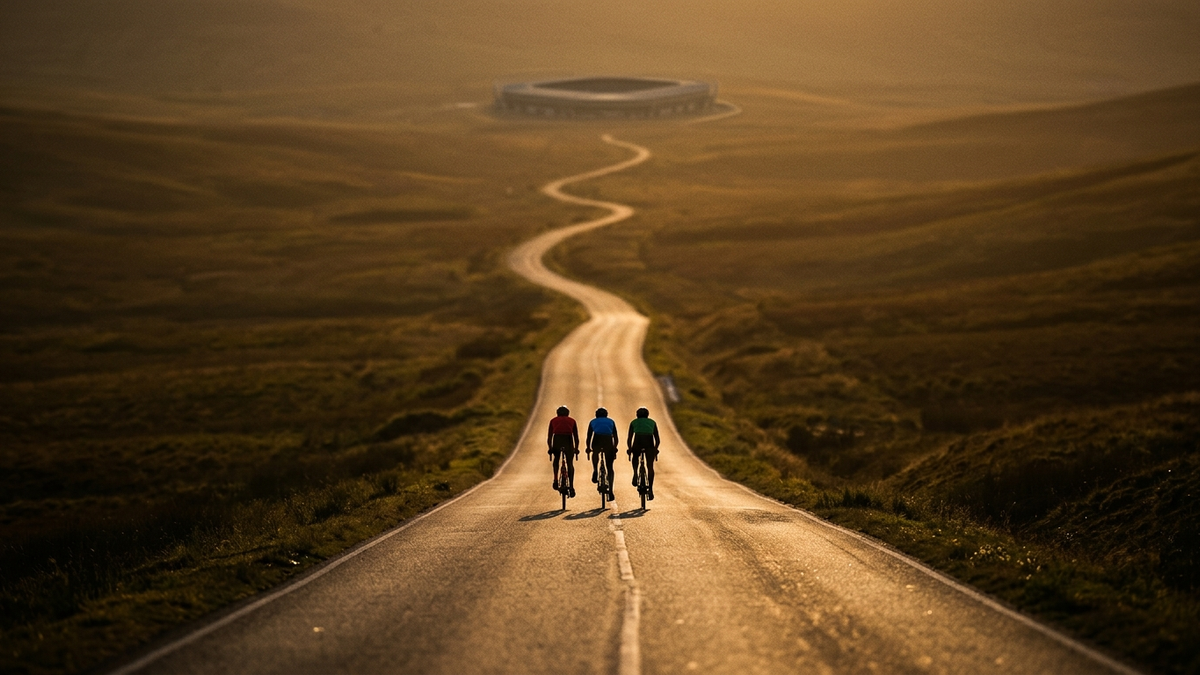
Three men on bicycles rolled into Kansas City this week with sun-cracked faces, frames caked in continental dust, and a story that does not really compute on a spreadsheet. They left Gualeguaychú, a river town in Entre Ríos province, and pedalled 10,500 miles north through the Americas to watch Argentina kick off their World Cup. The BBC filmed them arriving in Missouri, grinning, slightly disbelieving, as if the legs had carried them somewhere the brain had not quite caught up to.
The market has caught up. Argentina sit at 8.95% on the tournament winner market on Polymarket, fifth-favourite behind France, Spain, England and Portugal. That is the gap between a journey that already feels mythic and a tournament outcome that, in implied-probability terms, almost certainly ends in disappointment. Worth sitting with for a moment.
Deposit $20, get $50 to trade
Welcome bonus on the world's largest prediction market.
18+ · New users only · Availability and terms vary by region · Trading involves risk of loss · BeGambleAware.org
The price of a defending champion
Reigning champions are usually priced like a hangover. Argentina lifted the trophy in Qatar and the market has spent the cycle since then quietly downgrading them, partly on age, partly on the strength of the European field, partly on the simple maths of a 32-team knockout. France lead at 17.05%, Spain are right behind at 15.95%, and England's 11.45% reflects a Tuchel project that traders seem more willing to back than the English press is.
Argentina's 8.95% is not a vote of no confidence. It is a vote of realism. Lionel Messi is confirmed in the final 26-man squad at 38 and will captain a sixth World Cup (a minor hamstring scare at Inter Miami is not considered serious, and he is expected to be fit), Julián Álvarez carries the central striker burden, and the spine of Romero, Mac Allister, Enzo Fernández and De Paul is still one of the better midfield-and-defence combinations in the field. The market is saying: this team is good, the draw is fine, and roughly one in eleven scenarios ends with them lifting it again. That is not nothing. It is also not a story you cycle 10,500 miles to bet on.
Group J reads kindly on paper. Algeria, Austria and Jordan are the company in the group stage, and Argentina would be heavy favourites to top it. The trouble starts later. A 32-team knockout means six wins from the round of 32 onwards, and the implied probabilities behind those tournament prices compound brutally once you start multiplying through brackets. A 70% favourite in each of six knockout rounds still only wins the tournament 12% of the time. Argentina are not 70% favourites in any plausible quarter-final.
Why fans and traders look at the same tournament differently
The three cyclists are not pricing a probability distribution. They are pricing a feeling, the same feeling that put a million Argentines on the streets of Doha in December 2022 and the same one that has people booking flights to East Rutherford for a final their team might not reach. Traders price the median outcome. Fans price the tail.
This is why prediction markets and sports betting diverge from fan sentiment in interesting ways during major tournaments. A 9% chance is not a small number if you treat it as the chance your life acquires a story you will tell at family dinners for the next forty years. It is a small number if you treat it as a coin you have to flip eleven times to win once. Both framings are correct. They are just measuring different things.
The BBC clip does not mention odds, prices or implied probabilities. It does not need to. The drama is that three friends spent something close to two years of their lives in the saddle to attend, in person, an event whose most likely outcome for their team is elimination somewhere between the round of 16 and the quarters. That is the texture markets do not capture. The Polymarket book tells you what is likely. It tells you nothing about why anyone would care.
The opening match the market is barely watching
Argentina open against Algeria, and the group-stage prices for Group J winner sit on Betfair Exchange rather than Polymarket, which does not currently run per-group markets for the 2026 tournament. The honest read is that Argentina topping Group J is close to a formality in expected-value terms, which is also why there is no especially juicy trade there. The interesting prices live deeper in the bracket, in the quarter-final matchups that have not yet been drawn and in the top-scorer market, where Messi sits just under 5%, now behind a cluster that includes Mbappé, Kane, Oyarzabal, Haaland and a narrowly-ahead Ronaldo.
For the cyclists, none of that matters on the day. They will be in a stand somewhere in the Kansas City metro, watching the team they pedalled across two continents to support, and the market's view of their odds will be entirely irrelevant for ninety minutes plus stoppage. That is the right answer for them. It is also why we cover these markets at iPredicta the way we do, as a lens on what traders collectively think will happen, not as a verdict on what is worth caring about. Argentina at 8.95% is a price. The 10,500 miles is the story.

Frequently asked questions
Why are Argentina priced so low if they are the defending champions?
Defending champions almost always trade at a discount to their tournament-win pedigree, because the underlying maths of a 32-team knockout punishes everyone. Argentina's 8.95% on Polymarket reflects the strength of France, Spain and England at the top of the market, the age of Messi and parts of the squad, and the simple fact that winning six knockout games in a row is hard regardless of who you are.
Does the Polymarket price account for home-continent advantage for Argentina?
Partially. The 2026 tournament is hosted across the United States, Canada and Mexico, which is closer to home for South American sides than a European or Gulf host. Traders have priced Argentina and Brazil in the same broad band as Portugal and slightly behind the top European contenders, suggesting the geography is already baked in rather than offering an untapped edge.