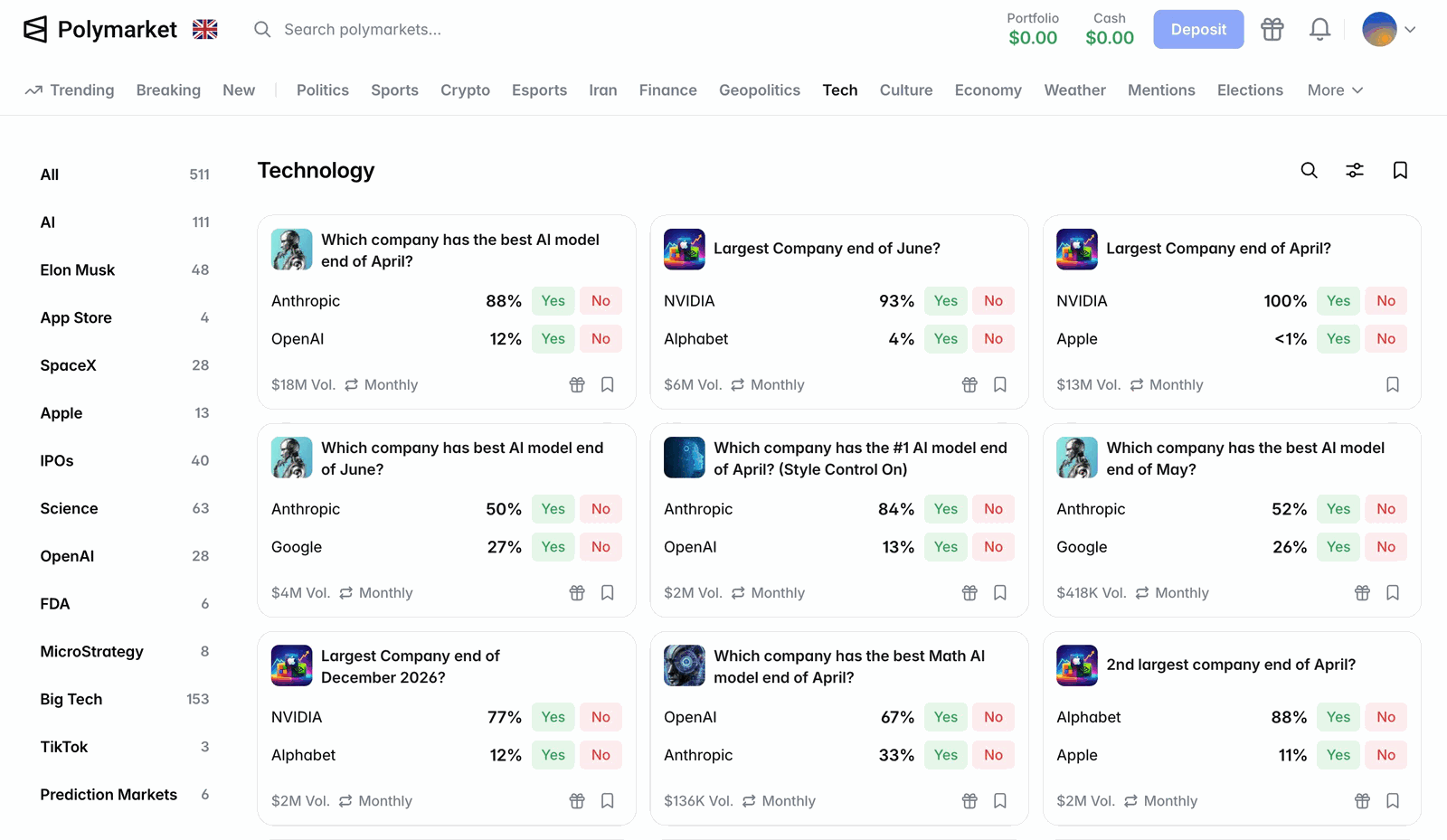
A prediction market is a place where you can buy and sell contracts that pay out based on whether a real-world event happens. The simplest version: a contract that pays $1 if the event occurs and $0 if it does not. You can buy the "Yes" side, sell the "No" side, or do the opposite. What you pay for the contract is the market's current estimate of the probability. A contract trading at $0.65 means the market currently thinks there is roughly a 65% chance the event happens.
That is the mechanism. Its consequences are more interesting. Prediction markets turn questions about the future, elections, interest rates, sporting outcomes, weather, the timing of product launches, into prices. Prices are information. They update continuously, weight evidence by how much real money people are willing to stake, and aggregate the views of anyone willing to trade. Researchers have used them since the 1980s as forecasting tools. Wall Street desks use them as a hedging instrument. Journalists now cite them alongside polls.
The 2024 US election was the moment prediction markets became mainstream. Polymarket processed over $3 billion in election contracts. Kalshi won a landmark court case allowing it to offer political event contracts under CFTC regulation. In the UK, Betfair Exchange's political book saw its heaviest volumes in decades. In April 2026, the total prediction-markets industry is processing something like $200 billion a year in contract volume, with Kalshi alone expected to exceed $100 billion this year. The category has moved from obscure academic tool to regulated financial product in about thirty-six months.
This guide explains what prediction markets are, how they work, how they differ from the things they are sometimes confused with (sportsbooks, polls, derivatives), and why they matter. No prior finance knowledge required. This is an educational overview, not investment advice.
Deposit $20, get $50 to trade
Welcome bonus on the world's largest prediction market.
18+ · New users only · Availability and terms vary by region · Trading involves risk of loss · BeGambleAware.org
The core mechanic
Every prediction market contract is a binary option with a $1 payoff. The contract asks a clearly-defined question, "Will the Federal Reserve cut rates at its June 2026 meeting?" or "Will Manchester City win the Premier League 2025 to 26?", and has exactly two possible outcomes: Yes or No. When the event resolves, one side of the contract pays $1 and the other pays nothing. Between now and resolution, the contract trades at some price between $0 and $1 that reflects the market's probability estimate.
Suppose you buy a Yes contract at $0.40. Three things can happen. The event occurs and your contract settles at $1, giving you a $0.60 profit (150% return). The event does not occur and your contract settles at $0, losing your $0.40. Or the price moves before the event resolves, say to $0.55, and you sell early for a $0.15 profit. Early exit is possible whenever the market has enough liquidity to absorb your order.
The No side works the same way in reverse. Selling Yes at $0.40 is economically equivalent to buying No at $0.60, because the two sides always sum to $1. This is why prediction markets are sometimes called "zero-sum": every dollar one side wins comes from the other side's stake.
How a contract price becomes a probability
Where the probability comes from
A prediction market's probability is not set by an expert or a bookmaker. It is set by the trading price, and the trading price is set by whichever side has more demand. If lots of people buy Yes contracts at $0.40, the price moves up. If lots of people sell Yes, the price moves down. The price settles wherever buyers and sellers are willing to transact.
This is the feature that makes prediction markets interesting as a forecasting tool. Unlike polls, which sample opinions, or expert forecasts, which sample one person's view, prediction-market prices aggregate the views of everyone willing to put money on their belief. Weighted, usefully, by conviction, people with strong views take larger positions, people with weak views take small ones or stay out. Research from the 1990s onward consistently finds prediction-market probabilities are better-calibrated than expert forecasts for events where the market has adequate liquidity and time to aggregate information.
The caveat is the liquidity condition. Thin markets, ones with few traders and low volume, produce noisy prices that reflect whoever shows up rather than the collective wisdom of the crowd. The accuracy argument applies to liquid markets. A $1 billion book on the 2024 US presidential election produced meaningful probabilities. A $500 book on a niche entertainment question produces a number that is mostly noise.
A brief history
The modern prediction market traces to the Iowa Electronic Markets, launched at the University of Iowa in 1988 as an academic experiment in election forecasting. IEM ran on a no-profit basis under a specific CFTC exemption and established the template for what prediction markets could do: binary contracts, continuous trading, small-stakes retail participation.
The 2000s brought the first wave of commercial platforms. Intrade, Irish-based, dominated the mid-2000s and became the go-to venue for political prediction markets until it shut down in 2013 following a US regulatory dispute. Betfair Exchange, launched in the UK in 2000, developed the peer-to-peer betting model that looks most like prediction markets, though under UK law, it is regulated as a betting exchange rather than a financial product.
The post-2020 period has been the inflection. Kalshi launched in 2021 as the first US-based, CFTC-designated prediction-market exchange. Polymarket launched in 2020 on crypto rails from an offshore base and grew explosively through the 2022 to 2024 period. Augur and other decentralised experiments came and mostly went. The institutional arrival came in 2025: Polymarket's QCEX acquisition, Kalshi's Series E at $11 billion, Robinhood launching event contracts, Crypto.com partnering with prediction-market infrastructure. By early 2026 the category has moved from fringe to regulated financial product.
What prediction markets are not
A prediction market is not a sportsbook, though it can look like one when the contract is about a sporting event. A sportsbook sets the odds and takes the other side of your bet. A prediction market matches you against another user, someone else who believes the opposite. The sportsbook's margin comes from the vig on the odds. The prediction market's margin comes from a transparent fee on each trade. The economic consequences, particularly for tax treatment and consumer protections, differ materially, which we cover in our guide to prediction markets vs sports betting.
A prediction market is not a poll. Polls sample stated opinions from respondents who have no skin in the game. Prediction markets sample revealed preferences, the prices people are willing to pay, weighted by how much they pay. A poll shows what people say. A prediction market shows what people are willing to bet. The two sometimes converge, sometimes diverge, and the divergence is often the interesting signal.
A prediction market is not a derivatives exchange in the traditional sense, although under US law Kalshi and Polymarket US are both designated contract markets, the same legal category as commodities futures exchanges. The distinction is that traditional derivatives reference prices of commodities or financial assets, whereas prediction-market contracts reference yes/no outcomes of events. Economically both are bets on uncertain futures, but the regulatory treatment and risk characteristics are different enough that they have historically been treated as distinct products.
Why they matter now
Three things have changed to make prediction markets interesting in 2026 in a way they were not in 2020.
First, regulatory clarity. Kalshi's election-contracts victory in late 2024 and the CFTC's subsequent approvals have put prediction markets on a firmer legal footing in the US than at any previous point. The state-level battles still to play out will shape the edges of the category, but the federal status is settled enough for institutional capital to engage. For more on the legal picture, see our guide to whether prediction markets are legal in the US.
Second, volume. The 2024 election proved the demand side, Polymarket alone saw $3 billion-plus in election contracts. Kalshi's 2025 volume exceeded $43 billion. The category is no longer niche. Order books are deep enough to support institutional hedging, academic research, and retail speculation at the same time, which is the regime that makes prediction markets genuinely useful as forecasting instruments.
Third, integration. Robinhood's 2025 rollout of event contracts to its 100-million-user base is the single biggest channel for mainstream adoption. Prediction markets stopped being a standalone category and became a feature available inside mainstream brokerage apps. That is how niche financial products graduate. Options trading went through the same transition in the 1980s and 1990s.
How to think about getting started
For US users, start with Kalshi. The account-opening flow is simple, funding is via familiar banking rails, and the market coverage is broad. Place a small first trade, $10 or $20, on a market you have a genuine view on. Pay attention to how the price moves between your entry and resolution. The intuition for how prediction markets behave builds faster through a handful of small real trades than through any amount of reading.
For UK users, Betfair Exchange is the practical starting point. The UI is dated but the underlying mechanics are the same as any modern prediction market, and the political book in particular is liquid. Smarkets is a commission-friendlier alternative. Neither is labelled a "prediction market" under UK law, they are betting exchanges, but the product mechanics are essentially identical. For the full picture on what UK users can access, see our guide to whether prediction markets are legal in the UK.
For readers who simply want to watch the space without trading: follow price movements on markets you know about. Use an aggregator that shows live prices across platforms without requiring you to sign up to each individually. The educational value of watching a market price evolve in real time as news breaks is substantial, and costs nothing.

How iPredicta fits in
iPredicta is built to make prediction markets legible. We aggregate live prices from Polymarket, Kalshi, and other venues, show where the best odds are across platforms, and flag meaningful price movements before they make the news cycle. For someone learning how prediction markets work, we provide something the individual platforms do not: a neutral place to see what is happening across the entire category without needing to hold accounts on multiple platforms.
As the category expands and more regulated platforms launch, we will track them all. One platform. Every market. Smarter decisions.
Frequently asked questions
What is a prediction market?
A prediction market is a platform where users buy and sell contracts that pay out based on whether a real-world event happens. Each contract has a binary outcome, Yes or No, and pays $1 if the outcome occurs or nothing if it does not. The trading price between $0 and $1 represents the market's current estimate of the probability. A contract trading at 65¢ implies a 65% probability. Markets exist on elections, economics, sports, crypto, climate, and many other topics.
How do prediction markets work?
You buy a Yes or No contract at the current market price. If your side wins when the event resolves, your contract settles at $1; if it loses, it settles at $0. You can also exit early by selling your contract back into the market at whatever the current price is. Prices move continuously based on order flow, if more users want to buy Yes than sell it, the price goes up. Platforms make money through small per-trade fees, not by taking the other side of bets.
Are prediction markets accurate?
In liquid markets with enough volume and time to aggregate information, prediction-market probabilities are typically better-calibrated than expert forecasts and statistical models. Research from the Iowa Electronic Markets and academic studies of betting exchanges has consistently supported this. The accuracy depends on liquidity, thin markets with few traders produce noisy prices that reflect whoever shows up rather than collective wisdom. Major political and economic markets with millions of dollars in volume produce meaningful probabilities; niche entertainment markets with low volume often do not.
What is the difference between a prediction market and a sportsbook?
A sportsbook is a bookmaker, it sets the odds and takes the other side of your bet. Its profit comes from the vig built into the odds, typically around 4 to 5%. A prediction market is an exchange, it matches you against another user who believes the opposite, and the platform makes money from a transparent per-trade fee, typically a penny or two per share at most and charged only to the side taking an existing price. Prediction markets also let you exit positions before resolution and tend to produce more accurate probability estimates because their pricing is set by trading rather than by an operator.
Who regulates prediction markets?
Regulation differs by country. In the United States, CFTC-designated platforms like Kalshi and Polymarket US are regulated as derivatives exchanges under the Commodity Exchange Act. In the United Kingdom, the UK Gambling Commission treats prediction-market operators as betting intermediaries under the Gambling Act 2005, although dedicated UK guidance has not yet been issued. The same product can be a financial derivative in one jurisdiction and a regulated bet in another, which has significant consequences for licensing, consumer protection, and tax treatment.