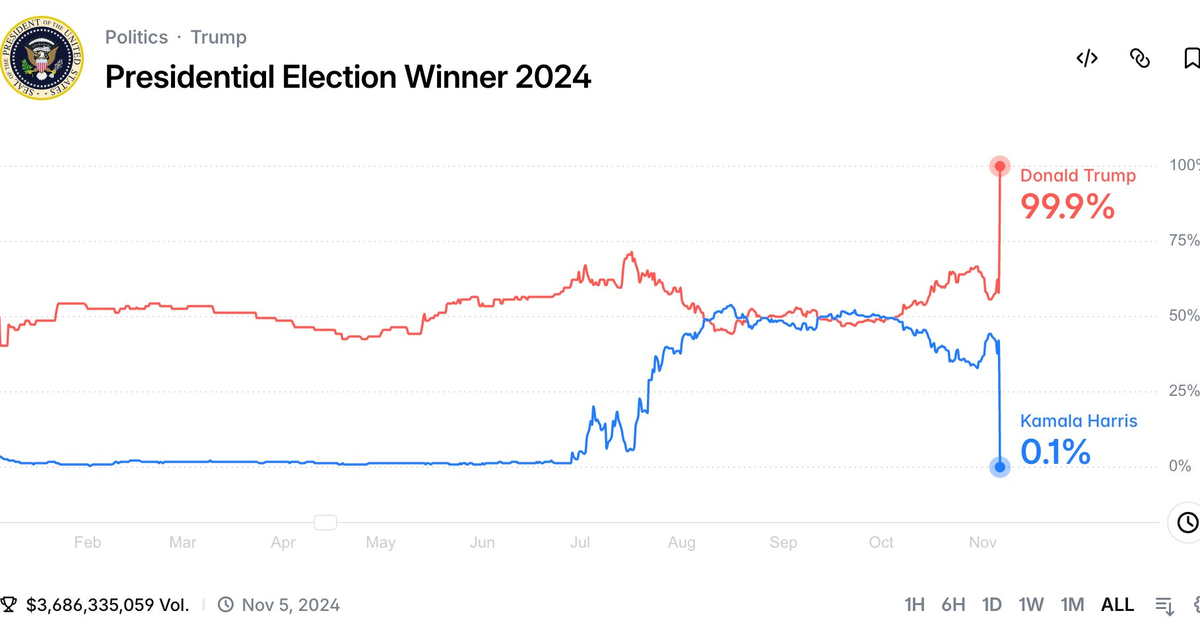
On the morning of 5 November 2024, the polls said the US presidential race was a coin flip. Polymarket had Trump at 60 per cent. By dinner time on the East Coast that number had climbed to 80, then 90, then the race was called. The poll aggregators were still showing tossup numbers that night.
Anyone watching both at once would have been forgiven for asking the obvious question. If a public market, open to anyone with twenty quid and a stable internet connection, was reading the result more clearly than the polling industry, what does that tell us about which one we should be paying attention to?
The honest answer is messier than the takes you saw on X. Prediction markets are not always more accurate than polls. They are not less accurate either. They are measuring something subtly different, and once you understand how prediction markets work, the comparison stops being a horse race and starts being a useful tool.
This is the breakdown.
Deposit $20, get $50 to trade
Welcome bonus on the world's largest prediction market.
18+ · New users only · Availability and terms vary by region · Trading involves risk of loss · BeGambleAware.org
What polls are actually measuring
A poll is a snapshot. A pollster picks a sample, a few hundred to a few thousand people, ideally weighted to look like the wider population, and asks them a question. The output is an estimate of what the broader population would say if you asked everyone.
Polls answer the question "what do people say they will do." That is a useful question, but it has well-known weaknesses. People lie. People change their minds. People who pick up the phone to talk to a pollster are not always representative of people who do not. Modern pollsters spend a lot of time and money trying to correct for this with weighting, panel design and likely-voter screens, and most of the time they do a respectable job. But the gap between stated intention and actual behaviour is the structural weakness that polling has never fully closed.
Polls also work in time horizons that lag reality. A poll fielded over four days, weighted, written up and published, is showing you what people thought about a week ago. In a fast-moving race, a week is a long time.
What markets are actually measuring
A prediction market does not ask anyone what they will do. It asks them to put money behind what they think will happen. The price of a yes contract on Polymarket or Kalshi is, in theory, the consensus probability of that event among the people willing to bet on it.
That is a different question, and the difference is important. Markets are forward-looking. They aggregate not just intention but everyone's read of intention, your friend who watches three swing-state TV stations a day, the analyst with a model, the casual punter who saw a headline. All of that gets compressed into a single number that updates in real time.
When a market moves, you do not need a press release to tell you something changed. The price tells you. That immediacy is the single biggest advantage markets have over polls.
The 2024 election: what the data actually shows
This is the case study everyone reaches for, and for good reason. In the final two weeks before polling day, the major US poll aggregators, 538, the Economist, Nate Silver's Silver Bulletin, all had the race inside the margin of error. Most of them gave Kamala Harris a slight edge. The polling consensus was that this was the closest election since 2000.
Polymarket disagreed. From mid-October onwards, Donald Trump traded at 60 per cent or higher on the platform, and that price held up under several rounds of scrutiny when journalists discovered that a single French trader had placed enormous bets that were partly responsible for moving the line. Even after that flow normalised, the market held.
On the night, the market was right. The polls were not exactly wrong, many state-level polls were inside their stated margin of error, but the aggregate story they told was misleading. Markets had been telling a different story for weeks.
That is one election. Reading too much into a single data point is how you get the next prediction wrong. The 2022 US midterms went the other way: markets overpriced Republican gains and the polls, on average, did better. Markets are an instrument, not an oracle.
Where markets beat polls
Speed. A market price updates in seconds. A poll updates every few days at best. When something happens, a debate moment, a leaked email, a candidate dropping out, the market repriced before most journalists have hit publish on the analysis.
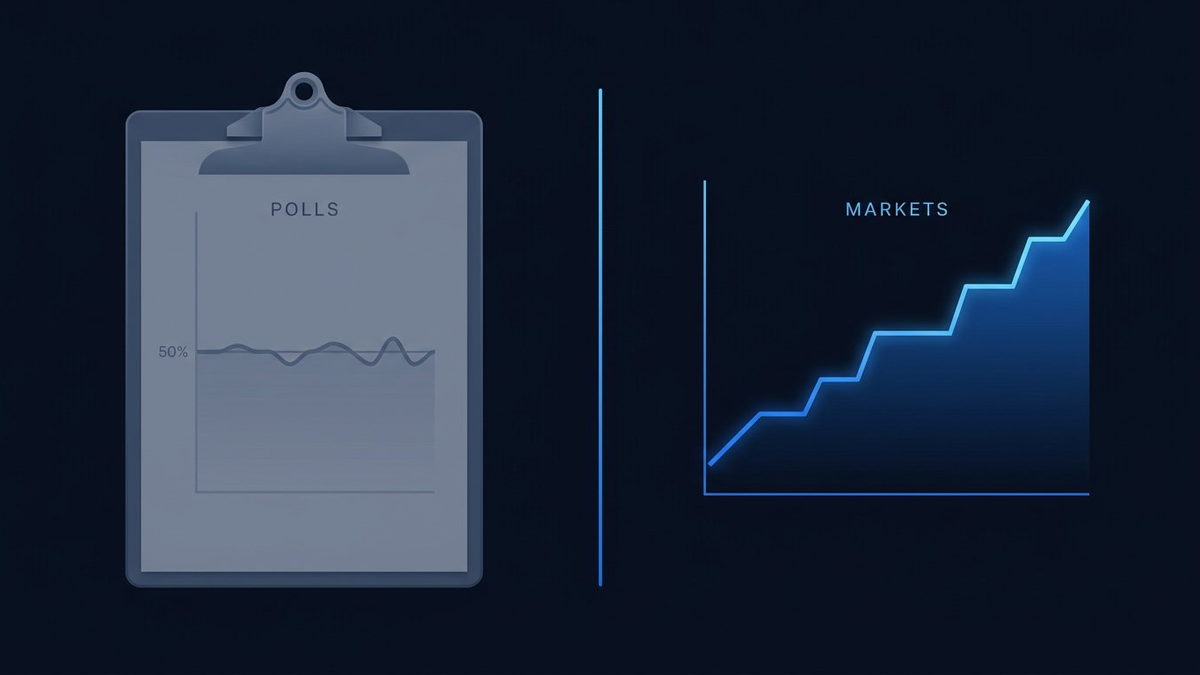
Real money. The discipline imposed by people putting actual cash behind their views is real. It is not perfect, but it filters out the kind of casual lying that distorts polling. If you tell a pollster you are going to vote, you might. If you bet £500 that you will, you probably mean it.
Aggregation. A market price is a weighted average of every trader who has acted, with the weights set by how much they staked. That is a different aggregation than a poll, and on questions where information is unevenly distributed, where a few people know much more than the average, it can be more accurate.
Where polls still win
Sample representativeness. The people who trade on Polymarket are not a random sample of voters. They skew young, male, online and in some jurisdictions outside the US. A poll, done well, is an attempt to actually mirror the electorate. If you want to know what voters think, polls are still doing the job markets do not even attempt.
Liquidity. On thinly traded markets, local elections, obscure policy questions, anything outside the marquee races, prices are often noisy and can be moved by small bets. The 2024 presidential market on Polymarket had hundreds of millions of dollars of volume. A market on the next French regional election does not. Treat low-volume markets with the same scepticism you would treat a poll with a sample size of 200.
Calibration on rare events. Markets struggle with very low or very high probabilities. A 2 per cent contract on Polymarket trades in ways that often do not reflect a true 2 per cent probability, there is structural reasons for this involving the cost of capital and the spread, but the upshot is that markets are most useful in the messy middle, not at the tails.
How to read both at once
The serious analysts use both. Polls tell you what people are saying. Markets tell you what people who have skin in the game think will actually happen. When the two agree, that is a strong signal. When they diverge, as they did in October 2024, that is interesting, and worth digging into.
The question to ask is always: why is the market different from the poll? Sometimes the answer is that the market knows something the poll cannot capture. Sometimes the answer is that a single trader is moving the line. The skill is telling those two situations apart. If you want to compare Polymarket and Kalshi on the same question, the divergences between the two venues themselves are often as informative as the gap between any market and the polls.

The bottom line
Prediction markets are not a replacement for polls. They are a different instrument, measuring a different thing, and they have their own weaknesses, liquidity, sample bias, vulnerability to large traders. But on the questions that matter most, fast-moving races, big binary outcomes, the kind of events where being right early is worth something, markets have a track record that the polling industry can no longer ignore.
If you have only ever read polls, you have been getting half the picture. If you have only ever traded markets, you have been ignoring the other half. The investors and journalists getting this right are the ones reading both. UK readers should also note the UK regulatory position on these venues, and US readers the US legal landscape, before deciding where to participate. If you want to start trading on Polymarket or trade on Kalshi, iPredicta surfaces live prediction market data across both in one place.
Frequently asked questions
Are prediction markets more accurate than polls?
In recent US presidential elections prediction markets called the result earlier and with more confidence than most polling aggregators, but the picture is not a clean win, markets price what traders think will happen, not what the electorate is doing right now, and that difference matters in fast-moving races.
Did Polymarket predict the 2024 US election correctly?
Polymarket priced Donald Trump as the favourite for most of the final stretch of the 2024 race and held that price through election night, while major poll aggregators showed a near tie. The market was directionally right earlier than the polling consensus.
Why do prediction markets sometimes get things wrong?
Markets can be moved by a small number of large traders, by herding behaviour, and by liquidity gaps on contracts that are unfamiliar to most users. They are not magic, they are an aggregation of bets, and bets reflect the people placing them.
Are prediction markets a replacement for polls?
No, and most analysts using both treat them as complementary. Polls measure stated voter intention from a sample. Markets price the probability of an outcome. The two answer different questions, even when the headline number looks similar.