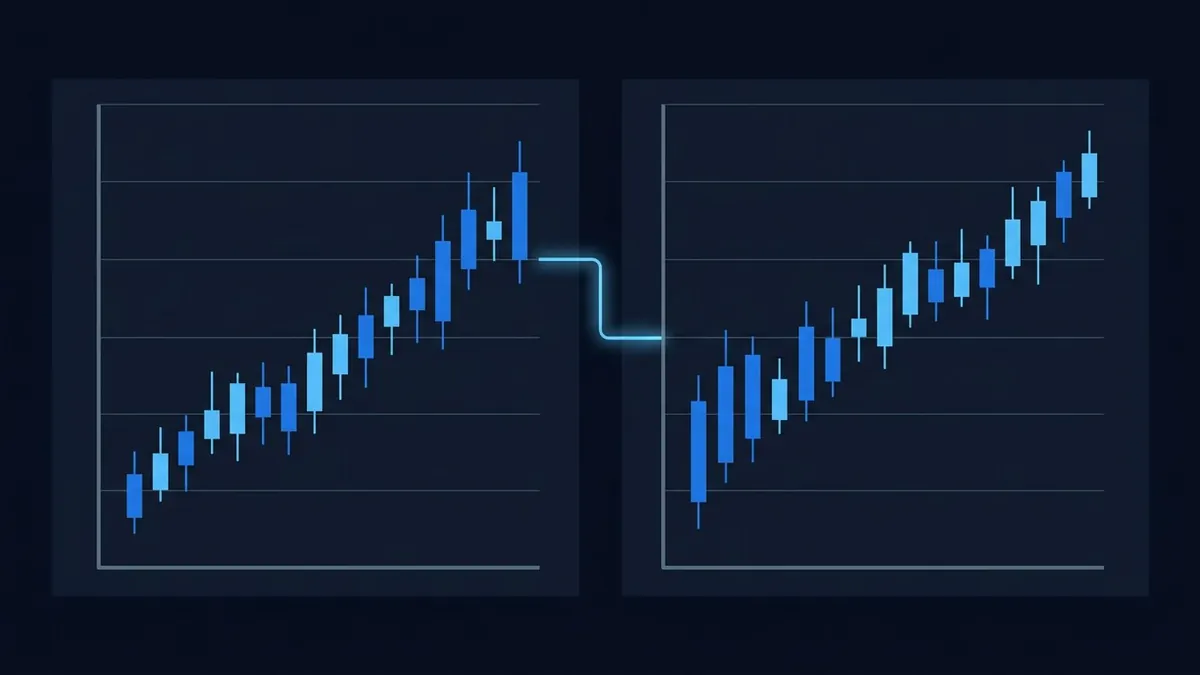
There is a particular kind of trader who reads about prediction markets, opens both Polymarket and Kalshi side by side, sees that the same election is priced at 58 cents on one and 62 cents on the other, and feels their pulse quicken.
This is the arbitrage instinct. Buy the cheaper side, sell the more expensive side, lock in the four cent spread, walk away with money you did not need to be right about anything to make. It is the cleanest possible trade, risk-free profit, in the textbook sense, and on prediction markets it appears to be sitting in plain sight.
The reality is messier than the textbook. The arbitrage is real, the gaps exist, and people are making money from them. But the friction between the headline number and the cash in your account is much larger than most newcomers realise. This is what is actually going on. If you are still getting comfortable with how prices and probabilities relate, our guide to how prediction market odds work covers that ground first.
Deposit $20, get $50 to trade
Welcome bonus on the world's largest prediction market.
18+ · New users only · Availability and terms vary by region · Trading involves risk of loss · BeGambleAware.org
The basic idea
Arbitrage in any market is the practice of profiting from a price difference that should not exist. In an efficient market, the same asset trades at the same price everywhere. In an inefficient market, and prediction markets, fragmented across platforms with limited overlap of users, are inefficient, the same outcome can be priced differently in different places.
On prediction markets the asset is a contract on an event. "Trump wins the 2024 election" is the same outcome whether you trade it on Polymarket, Kalshi, PredictIt or a niche crypto venue. If Polymarket says yes is worth 55 cents and Kalshi says yes is worth 60 cents on the day before resolution, those two prices cannot both be right. For a deeper read on the structural differences between the two main venues, see our piece on how to compare Polymarket and Kalshi.
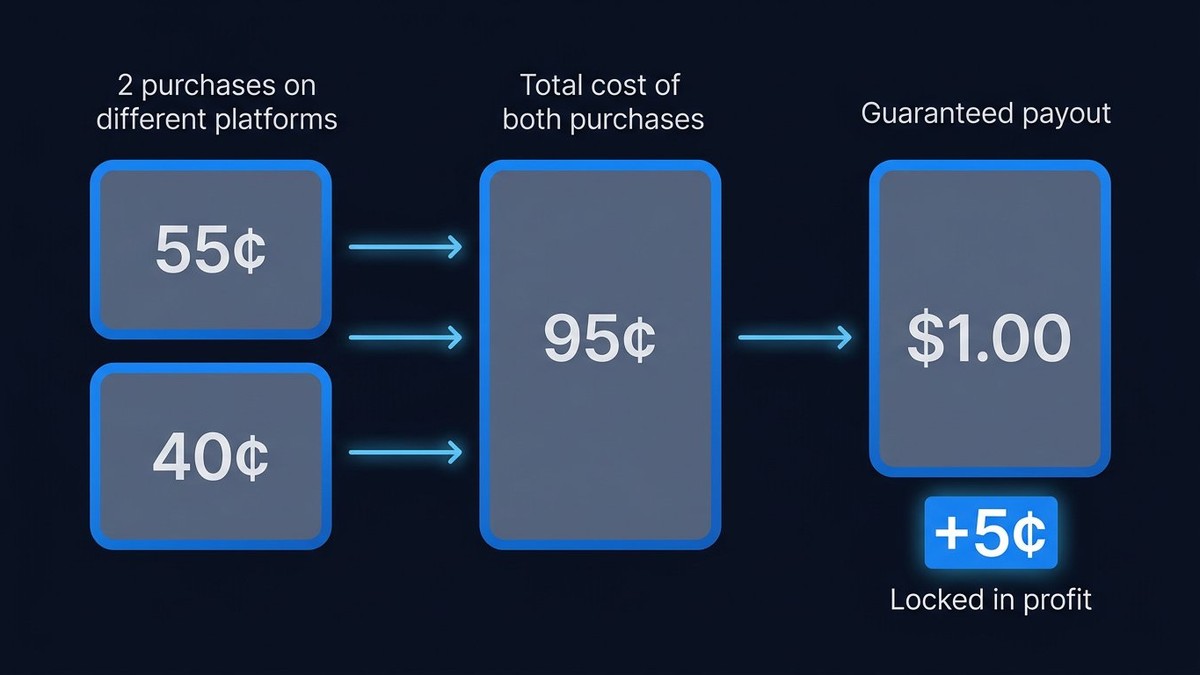
An arbitrageur buys yes at 55 on Polymarket and no at 40 on Kalshi (Kalshi prices yes at 60, so no is at 40). Total cost: 95 cents. Total payout: one dollar, regardless of outcome. Profit: five cents per contract, locked in.
Multiply by ten thousand contracts, and you have a serious return for the time it took to enter the trade. That is the appeal.
Why the gaps exist in the first place
If there is free money in the system, why has someone not arbitraged it away? Three reasons.
Jurisdictional fragmentation. Both venues have geographic restrictions, and they are not the same restrictions. The offshore Polymarket, which holds the deep books this kind of arbitrage needs, is geoblocked for US residents under the 2022 CFTC settlement; the separately regulated Polymarket US is open to them but is a different order book. Kalshi trades from many countries rather than the US alone, but its member agreement restricts a long list of them. The traders who can theoretically do the arb, the ones with accounts on both venues and resident somewhere that permits both, are a small subset of the user base on either platform. The price gap exists because the two pools of users do not overlap. Understanding the US legal landscape and the UK regulatory position is the first step to seeing why the venues remain so cleanly separated.
Liquidity asymmetry. A market may be the most liquid contract on Polymarket and a thinly traded niche on Kalshi, or vice versa. When liquidity is unbalanced, prices drift apart and stay apart longer, because the cost to bring them into line is higher than the gap.
Execution friction. Polymarket settles in USDC on Polygon. Kalshi settles in US dollars in a US bank account. Moving capital between the two takes time, costs money, and exposes you to currency risk if you are not based in dollars to begin with. The frictions add up to more than the headline spread on most trades.
How a real trade actually goes
Here is what the textbook arb looks like when you try to put it on. Say you spot Polymarket pricing yes at 55 cents and Kalshi pricing yes at 60. You decide to buy 1,000 contracts on each side.
First, you need capital on both platforms. Five hundred and fifty dollars of USDC on Polymarket. Four hundred dollars (1,000 no contracts at 40 cents) on Kalshi. If you have the funds idle on both, you are good. If you do not, you are now bridging USDC out, off-ramping to dollars, transferring to Kalshi, a process that takes hours at best, days at worst, during which the spread you spotted may have closed. If you are funding a Polymarket account from scratch, our guide to start trading on Polymarket covers the basics.
Second, you need both legs to fill at the prices you saw. On a liquid market, that is usually fine. On a thin one, you will move the price as you fill, buying 1,000 yes contracts on Polymarket might walk the price from 55 to 57 by the time your full order is in. The other side might do the same. Suddenly your locked-in spread is two cents, not five.
Third, you need both platforms to resolve the market the same way. This sounds trivial, but it is not. Polymarket and Kalshi sometimes use different sources to settle the same event. The Kalshi settlement mechanics, covered in detail in our Kalshi event contracts piece, are not always identical to Polymarket's UMA-based system. If a US Senate race is contested or recounted, the two platforms might call it on different days, or in extreme cases differently, leaving you with a losing leg you assumed was a winner.
Then there are the fees. Trading fees on both platforms. Withdrawal fees. Bridge fees if you are moving crypto. FX costs if you are based outside dollar land. By the time the smoke clears, your five cent spread might be one cent of profit, or zero, or negative.
Where the real money is
The traders making consistent money from prediction market arbitrage are not the ones spotting gaps and putting on manual trades. They are running automated systems that monitor every contract on every venue continuously, ingest the prices into a single book, and fire trades when the spread net of fees crosses a threshold.
These systems compete with each other, which means the most obvious gaps close in seconds. What is left is the long tail, illiquid markets, fast-moving events, niche outcomes, where the arb is real but execution is harder. Edge in this game is measured in fractions of a cent, won by being faster and cheaper than the other systems doing the same thing.
If you are doing this manually you are competing with people who are not, and you will lose. Not because the arbs are not there, but because by the time you see them and act, the bots have already cleared the easy ones.
Same-platform arbitrage
There is a different, more accessible flavour of arbitrage that sits within a single platform. Polymarket and Kalshi both list multi-outcome markets, "who will win the Republican nomination" with a dozen candidates, alongside related two-outcome markets, "will the nominee be Trump."
If the prices on the multi-outcome market and the two-outcome market diverge, if Trump is priced at 75 per cent in the head-to-head and the multi-outcome market has him at 72, there is an arbitrage between them, on the same platform, in the same currency, with the same fee schedule. No bridging. No FX. No settlement risk.
These intra-platform arbs are smaller in size but cleaner to execute, and they are where most retail arbitrageurs cut their teeth. They are also where automated systems are densest, so the windows are short. Worth knowing exist.
The risks no one talks about
Beyond the obvious, execution failure, settlement disputes, fees eating returns, the risk that catches arbitrageurs out most often is platform risk. Both Polymarket and Kalshi have, at various points, paused withdrawals, frozen accounts, or had operational issues that left users unable to access funds for days or weeks.
If you have a million dollars locked into an arb across two platforms and one of them suspends operations, the textbook says you still have the other side and your worst case is breakeven. The reality is that you have a million dollars stuck on a platform that is not letting you withdraw, while your other position is moving against you on a platform that is. Risk-free, in this game, is a strong word.

So is it worth doing?
Yes, with caveats. Same-platform arbitrage is a perfectly reasonable strategy for retail traders who want a low-variance way to compound capital while learning the platforms. Cross-platform arbitrage is a real opportunity but practically requires automation, multi-jurisdictional setup, and capital reserves on both sides. It is not a get-rich-quick play. It is a get-rich-slowly-by-being-very-careful play.
Most importantly, it is a skill that does not transfer cleanly from sports betting arbitrage. The mechanics are similar, but the failure modes are different, settlement risk, jurisdictional risk, smart contract risk in Polymarket's case. Treat it as a new discipline.
Once we launch the iPredicta arb feed, you will not need to monitor manually, you will be able to see live arbitrage opportunities across venues from a single screen. For now, knowing the mechanics is the foundation. The traders who understand why the gaps exist are the ones who will spot the edges others miss.
Frequently asked questions
What is Polymarket arbitrage?
It is the practice of buying contracts on the same outcome at different prices on different platforms, locking in a profit regardless of how the event resolves. If Polymarket prices Trump to win at 55 cents and Kalshi prices the same outcome at 60 cents, an arbitrageur can buy yes on Polymarket and no on Kalshi to capture the spread.
Is prediction market arbitrage legal?
That depends entirely on jurisdiction. The offshore Polymarket is geoblocked for US residents, while the separately regulated Polymarket US serves US users through its own, separate order book, and Kalshi can be traded from many countries, subject to the restrictions in its member agreement, which makes literal cross-platform arbitrage difficult for any single trader without a multi-jurisdictional setup. Within a single platform, arbitrage between different but mathematically equivalent markets is generally permitted.
How profitable is prediction market arbitrage?
Spreads on the most liquid markets are usually narrow, single cents, and once you account for fees, gas costs and execution risk, real-world returns are modest. The traders making serious money at this run automated systems that capture small edges at high volume rather than chasing dramatic single trades.
What are the risks of arbitrage trading?
Execution risk if one leg fills and the other does not, settlement risk if the two platforms resolve a market differently, currency risk on cross-border trades, and platform risk if either side suspends withdrawals. The maths look clean on paper. The execution rarely is.
Correction, 10 August 2026. An earlier version of this guide said that Polymarket cannot be used by US residents and that Kalshi cannot be used by users outside the US. Both were wrong. The offshore Polymarket is geoblocked for US residents, but the separately regulated Polymarket US is CFTC-designated and open to them; and Kalshi states that it can be traded from many countries, subject to the restrictions in its member agreement. The paragraph has been corrected, and the point it was making, that the two user pools barely overlap, is unchanged. The same wording survived in the answer to "Is prediction market arbitrage legal?" until 16 October 2026, when it was corrected to match.