If you have read about prediction markets in the US press over the last two years, the phrase "event contract" has probably come up. It is the term the regulators use, the term Kalshi uses on its own platform, and the term that increasingly appears in court filings as the legal definition of what these things are.
It is also a piece of language that does some heavy lifting. "Event contract" sounds technical, neutral, financial. "Bet on the election" does not. The difference between the two phrases is the difference between a regulated derivative and a state-by-state gambling product, and that is exactly why the term exists.
Here is what an event contract actually is, what makes Kalshi's version different from Polymarket's, and why the language matters. If you want the broader category context first, our explainer on how prediction markets work covers the foundations.
Deposit $20, get $50 to trade
Welcome bonus on the world's largest prediction market.
18+ · New users only · Availability and terms vary by region · Trading involves risk of loss · BeGambleAware.org
The mechanics
A Kalshi event contract is a derivative. You buy a contract for a fixed price, and it pays out one dollar if the event happens or zero if it does not. The price you pay is the implied probability of the event. For the underlying maths, see our breakdown of how prediction market odds work.
Mechanically, that is identical to a Polymarket contract. The maths is the same. The user experience is similar, a market page, a chart, an order book, prices in cents.
What is different is the wrapper. Kalshi is a CFTC-regulated designated contract market, the same regulatory category as a futures exchange. The contracts are listed under federal commodities law. Settlement is in US dollars to a US bank account. The user has to be a US resident, has to pass KYC, and has to fund a regulated account.
Polymarket has none of that. It is a decentralised protocol, settled on the Polygon blockchain in USDC stablecoin, with no US users permitted under the platform's geofencing. Same product. Different regulator. Different audience. Our piece on how to compare Polymarket and Kalshi walks through the practical implications side by side.
Why "event contract" not "bet"
The legal architecture matters. Sports betting in the US is governed by state-level gambling law that varies enormously between jurisdictions. To offer a bet on the Super Bowl in New York, you need a New York gaming licence. The same bet in California is illegal. The same bet in Nevada has been legal for decades.
A federal derivatives exchange is not subject to that patchwork. If a contract is a derivative under the Commodity Exchange Act, it is regulated by the CFTC, full stop. State gambling laws do not apply.
This is the legal trick at the heart of Kalshi's existence. By framing event contracts as derivatives, as financial instruments hedging against future outcomes, no different in legal category from a wheat futures contract, Kalshi can offer products on outcomes that would be illegal sports bets in 35 of 50 states. The CFTC blesses the contract, the contract is national, and the state regulators are theoretically pre-empted.
Theoretically, because the case law is still being made. Several states have challenged Kalshi's authority to list sports contracts in their jurisdictions, and the resolution of those challenges will shape the next few years of the industry. For the current state of play, see our state-by-state breakdown of the US legal landscape.
Settlement
Each Kalshi market has a settlement source defined upfront. For an election, it might be the Associated Press call. For a Fed rate decision, it is the FOMC press release. For an economic indicator, it is the official release from the relevant agency.
When the source confirms the outcome, the market settles automatically. Winning contracts pay out one dollar. Losing contracts go to zero. The settlement is transparent, defined in advance, and disputes are rare on the major markets, though not unheard of on edge cases.
This contrasts with Polymarket's UMA-based settlement, which uses an oracle network where token holders vote on outcomes. UMA has been broadly reliable but has had high-profile disputes in cases of ambiguous outcomes. Kalshi's centralised settlement is faster and cleaner; Polymarket's decentralised settlement is more resistant to single-point-of-failure but slower in disputes. The settlement gap matters in particular for traders running cross-platform prediction market arbitrage.
What you can actually trade
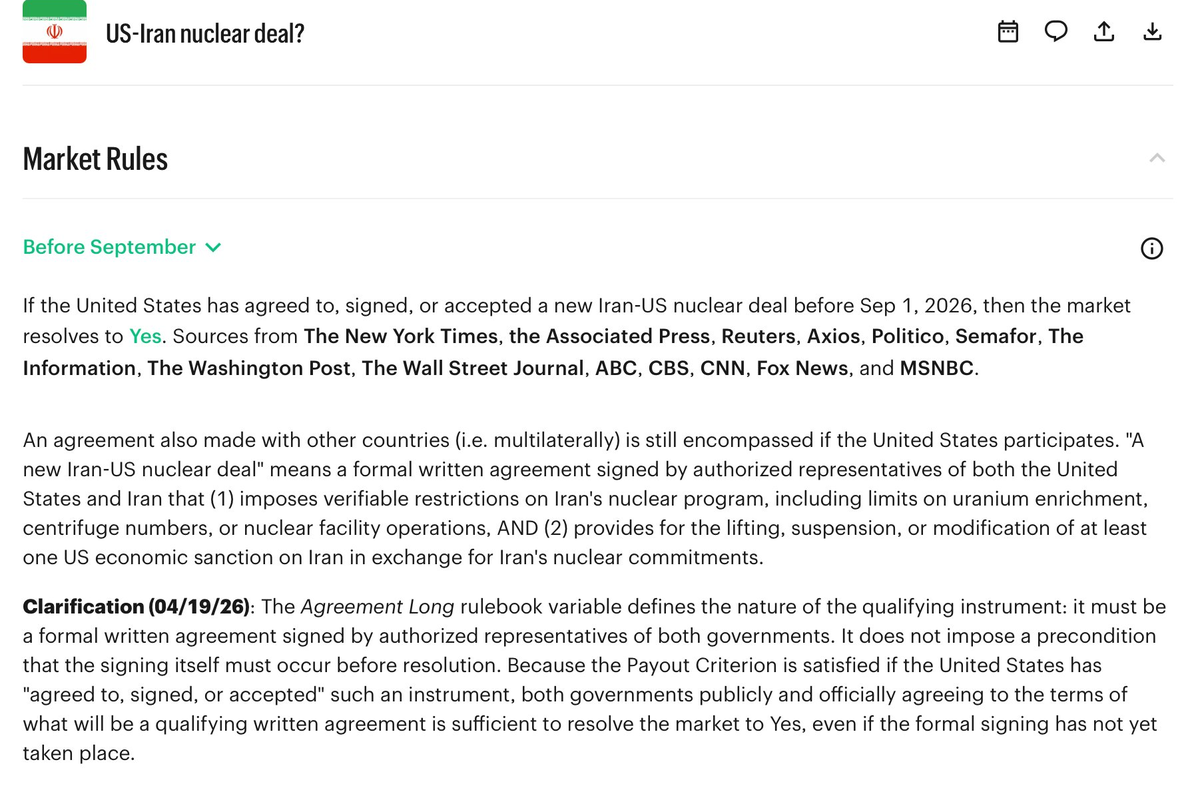
Kalshi lists hundreds of markets across politics, economics, weather, climate, awards, finance and more. Major categories include US elections, Fed rate decisions, inflation prints, jobs reports, tropical storms, monthly box office, year-end S&P levels, and a growing list of sports.
The sports list is contested. Kalshi's argument is that these are economic events on which traders may want to hedge. State regulators argue they look indistinguishable from sports bets. The litigation continues, and the list of available sports contracts has expanded and contracted depending on the state of the legal fight.

The bottom line
A Kalshi event contract is the same financial instrument as a Polymarket contract, in a different regulatory wrapper. For US users it is the only fully compliant way to trade on Kalshi, or any other event contract venue, outside of state-licensed sportsbooks. For traders in the rest of the world, Polymarket is the equivalent.
The language, "event contract," not "bet", is doing real legal work. It is not just marketing. Whether the courts agree that the work it is doing is legitimate is the open question that will define the platform's next chapter. iPredicta lets you trade Kalshi markets on iPredicta alongside live data from every major venue, so you can see where the sharpest pricing sits.
Frequently asked questions
What is a Kalshi event contract?
A Kalshi event contract is a regulated derivative that pays out one dollar if a specific real-world event happens, and zero if it does not. They are listed on a CFTC-regulated exchange and treated under US law as financial instruments rather than gambling products.
How is Kalshi different from Polymarket?
Kalshi is a CFTC-regulated US exchange that settles in dollars and is restricted to US users. Polymarket is a decentralised platform that settles in USDC stablecoin and is restricted to non-US users. The mechanics of the contracts are similar; the regulatory wrapper and user base are not.
How are Kalshi contracts settled?
Each market has a defined settlement source, typically a government release, a major news outlet, or an aggregator like AP. When the source confirms the outcome, contracts paying out at one dollar are credited to winning accounts and losing contracts go to zero.
Are Kalshi contracts the same as sports betting?
Legally and structurally, no. Sports betting in the US is regulated state by state under gambling law. Kalshi event contracts are federal derivatives under the CFTC. The line between the two has been the subject of ongoing legal action, particularly around sports-related markets.