A soybean trader at the CME watches a July contract drift three ticks lower and knows, roughly, what that means for her book: her margin call moves, her mark-to-market shifts, her hedge on next season's crop tightens or loosens by a calculable amount. A trader on Kalshi watching the odds of a Fed rate cut slide from 62 cents to 58 cents is doing something that looks similar. Prices moved. Money changed hands. A view got repriced.
But the two instruments are not the same animal, and treating them as such is how futures traders lose money on event contracts in their first month. The payoff shape is different. The margin mechanics are different. The regulator is often the same, which confuses things further. If you are coming from a futures desk and want to understand what prediction markets actually are under the hood, the honest answer is: they are closer to binary options on regulated exchanges than to the CME futures you already know.
Deposit $20, get $50 to trade
Welcome bonus on the world's largest prediction market.
18+ · New users only · Availability and terms vary by region · Trading involves risk of loss · BeGambleAware.org
The short answer, before the long one
A CME futures contract is a linear payoff on a continuous underlying. A prediction market contract is a binary payoff on a discrete event. That single distinction cascades into every other difference: how you size positions, how leverage works, how you exit, how you hedge, and how you think about risk.
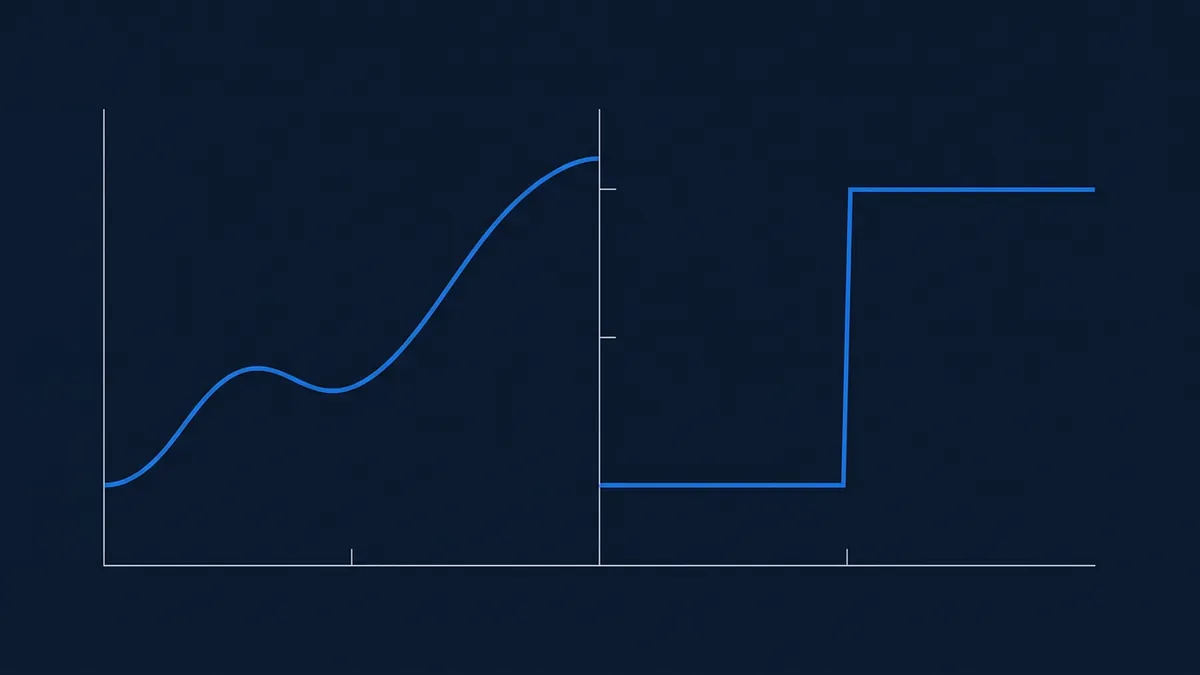
Futures let you express "corn goes higher" with a payoff that scales linearly with the corn price. Event contracts let you express "the CPI print comes in above 3.2%" with a payoff that pays $1 if yes, $0 if no. The first is a slope. The second is a cliff.
That cliff is the entire product.
Payoff shape: linear vs binary
Why does it matter that one is linear and the other is binary? Because your whole risk vocabulary has to change.
On a CME futures contract, a two-tick move against you costs you two ticks. A ten-tick move costs you ten. Losses scale smoothly, gains scale smoothly, and you can bleed slowly or violently but always proportionally. Delta is a number, not a step function.
On a Kalshi or Polymarket contract, the payoff at expiry is $1 or $0. Full stop. If you buy Yes at 40 cents and the event resolves Yes, you make 60 cents on the dollar. If it resolves No, you lose 40 cents on the dollar. The market can drift for weeks, but the terminal payoff is binary. Mid-life, the price moves continuously between 0 and 1, which lets you trade in and out like any other liquid contract, but at settlement the cliff is absolute.
The practical upshot: position sizing on event contracts is closer to sizing options than sizing futures. You are buying probability, and your maximum loss is your premium. There is no margin call spiral. There is also no gentle bleed; you are either right or you are not.
For a deeper walk-through of how the price maps to probability, our guide to what implied probability actually means on a prediction market covers the mechanics.
Margin, leverage, and the capital story
Here is where futures traders get tripped up. A CME S&P 500 e-mini carries a notional value in the hundreds of thousands of dollars, and its initial margin is only a fraction of that notional, which is exactly what makes it real leverage. CME resets the requirement as volatility moves, so check the current figure on CME's margin page before sizing anything rather than working from a number you read somewhere. A single tick is $12.50 and the contract can move dozens of ticks in a session.
Binary event contracts have no leverage in the futures sense. When you buy a Yes share at 40 cents on Kalshi, you post 40 cents. When you buy a No share, you post 60 cents. The exchange holds the full $1 of collateral between the two sides of the trade, because that is the maximum possible payout. There is no variation margin call because your loss is already fully funded at trade time.
One caveat that matters if you are comparing venues rather than instruments. Kalshi now also lists leveraged perpetual futures alongside its binary contracts, and those do carry margin and liquidation. Full collateralisation is a property of the binary event contract, not a blanket property of the exchange, and partial collateralisation of the binary contracts themselves is something the venues have been working towards rather than something that has arrived for retail.
That sounds restrictive to a futures trader used to controlling large notional with small capital. It is. But it also means a binary position cannot be liquidated. You cannot get a 3am call demanding you wire additional funds. The worst case is the premium you paid, known and capped at the moment of entry. Some traders find that boring. Others find it clarifying.
Underlying: continuous prices vs discrete events
A CME crude oil futures contract references a continuous, actively-quoted spot market with thousands of price levels per day. There is no ambiguity about what "the price of WTI at expiry" means; it is defined by settlement procedure against a liquid underlying.
Event contracts reference discrete outcomes. Did the Fed cut rates at the November meeting? Did the CPI print exceed 3%? Did a specific candidate win a specific state? These are yes/no questions, and the answer is determined by a resolution source: a government agency report, an official election result, a designated data feed.
That introduces something futures traders rarely think about, which is resolution risk. If the underlying data source is delayed, disputed, or ambiguous, the market has to resolve somehow, and the rules governing that resolution are the exchange's rules, not a spot market. Our explainer on how prediction markets actually decide who wins walks through the mechanics on both Kalshi and Polymarket.
The other consequence: the universe of tradeable questions on event contract exchanges is far broader than what CME lists. You can trade the outcome of a Fed decision, a jobs number, a Supreme Court ruling, a Best Picture Oscar, a Champions League final. Some of these have futures adjacent to them. Most do not.
Regulation: CFTC oversight, applied differently
Here is the confusing bit. Kalshi is a CFTC-regulated Designated Contract Market. So is the CME. The same regulator, same statute, same broad rulebook. Yet the products look nothing alike, and the compliance treatment for retail traders can feel worlds apart.
CME futures are institutional infrastructure with a retail wrapper on top. Kalshi is retail-first event contracts on the same regulatory rails. Polymarket, by contrast, operated for years offshore on crypto rails, largely outside CFTC oversight for US users. Its regulated US venue now runs under a CFTC order of designation obtained through the QCEX acquisition, settling in dollars through registered intermediaries rather than on crypto rails, and it is open to US users in the states that allow it, of which there are fewer than fifty. If you are trying to understand the current legal footing for a US trader, our breakdown of Polymarket's regulated US access covers what actually changed.
The regulatory gap that matters most to a futures trader: event contracts on gambling-adjacent questions (elections, sports outcomes) have been contested at the CFTC for years. Kalshi's election markets went through a federal court fight before they were allowed to list. Some states still push back on event contracts as gambling despite the federal CFTC framework. This is not a settled area. Futures on corn are settled. Event contracts on politics are still being litigated in real time.
Liquidity, spreads, and the execution reality
The CME e-mini S&P is one of the deepest markets on the planet. Bid-ask spreads are typically one tick. You can move real size without slippage.
Event contracts vary wildly. The headline markets on Kalshi and Polymarket, presidential elections, major Fed decisions, blockbuster sporting finals, can carry tens of millions in open interest and tight spreads. The long tail does not. A market on some obscure regulatory outcome six months out might trade at a 3-cent spread on a few hundred dollars of depth, which is fine for a personal position and useless for anything resembling institutional size.
That asymmetry matters for a futures trader used to sizing based on ADV. On event contracts, you have to check the book before you assume you can get in and out cleanly. Our note on what liquidity actually looks like on these venues gets into the specifics.

What a futures trader should actually do with this
So where does that leave you if you already trade futures and are curious about event contracts? Treat them as a different instrument class, not a variation on what you already do. The intuitions that work on continuous underlyings, adding to winners, scaling out with trailing stops, thinking in ticks and delta, do not port cleanly. Position sizing should look more like your options book: fixed premium risk, event-driven catalyst, binary payoff at expiry.
The edge, if there is one, comes from being right about discrete questions that the crowd is mispricing. That is a different skill from directional futures trading. It is closer to fundamental analyst work than to technical execution.
iPredicta tracks event contract markets across Kalshi, Polymarket, and the regulated venues that a US trader can actually access, with the odds, volumes, and resolution rules laid out plainly. If you are coming from a futures background and want to see the universe of tradeable questions before you fund an account, that is the starting point.
Frequently asked questions
Are prediction markets and futures regulated by the same agency?
In the US, both Kalshi and CME futures fall under CFTC oversight as Designated Contract Markets, but the products and their compliance treatment differ significantly. Kalshi lists event contracts under the same broad statute that governs CME futures, which is why it can operate legally in the US at the federal level. Polymarket historically operated offshore outside CFTC oversight for US users, and its regulated US path came later via an acquisition of a CFTC-registered venue. State-level friction adds another layer: some states still treat event contracts as gambling despite the federal framework, so the legal picture for retail traders is less uniform than it is for corn or crude futures.
Can you lose more than you deposit on an event contract like you can on futures?
No, binary event contracts on Kalshi and Polymarket cap your loss at the premium you paid, with no variation margin or liquidation risk. When you buy a Yes share at 40 cents, you post 40 cents and the exchange holds the full $1 of collateral between the two sides of the trade. If the market goes against you, the worst outcome is losing your 40 cents, not receiving a margin call for additional funds. This is fundamentally different from CME futures, where a large adverse move on a leveraged contract can trigger margin calls that exceed your initial deposit. The tradeoff is that event contracts offer no leverage in the futures sense; you fund the full potential loss upfront.
How is the payoff on a prediction market different from a futures contract?
Futures contracts have a linear payoff that scales continuously with the underlying price, while prediction market contracts have a binary payoff of $1 or $0 at resolution. A ten-tick move against your corn futures position costs you ten ticks; a ten-cent move against your Kalshi Yes position at expiry costs you nothing extra beyond the binary outcome. Mid-life, event contract prices move continuously between 0 and 1, so you can trade in and out like any other liquid market, but the terminal payoff is a cliff, not a slope. That changes how you size positions, hedge, and think about risk. It is closer to buying options than trading futures.
Do prediction markets offer leverage like CME futures?
No, binary event contracts on regulated US venues require full upfront collateral, so there is no leverage in the futures sense. On the CME, an e-mini S&P contract controls hundreds of thousands of dollars of notional exposure for an initial margin that is only a fraction of it. On Kalshi, if you want to make $60 on a Yes contract priced at 40 cents, you post the full 40 cents per share; the exchange holds the offsetting 60 cents from the No side. On the binary contract there is no notional leverage, no daily variation margin, and no forced liquidation. Worth knowing that this describes the instrument rather than the whole venue: Kalshi also lists leveraged perpetual futures, which do carry margin and liquidation. Some traders find the binary structure restrictive after futures. Others treat the capped downside as a feature, not a limitation.
Which is better for a retail trader, futures or prediction markets?
Neither is strictly better; they solve different problems and suit different skills. Futures are appropriate if you want directional exposure to continuous price series like commodities, indices, or rates, and if you are comfortable with margin mechanics and technical execution. Event contracts are appropriate if you want to express views on discrete outcomes like Fed decisions, elections, or specific data prints, and if your edge comes from analytical judgment on those questions rather than price action. Retail traders often find event contracts more approachable because the maximum loss is capped and the questions are legible. Futures reward execution discipline. Event contracts reward being right about discrete catalysts.