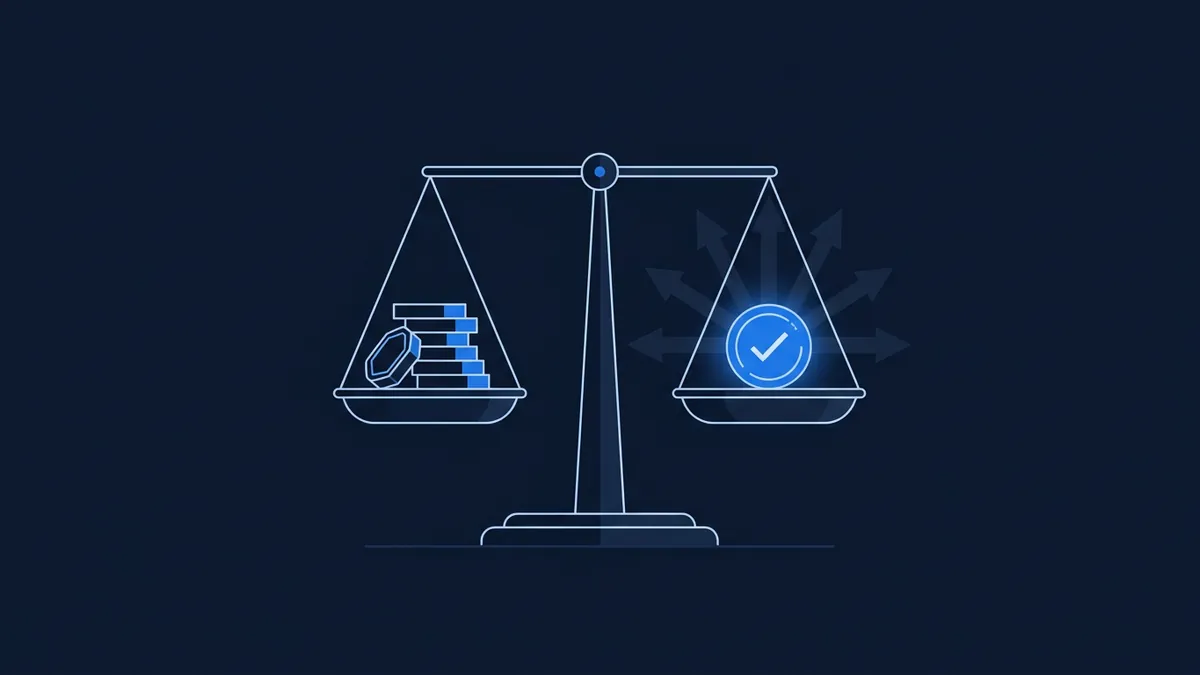
Picture a trader who just watched their YES shares on a political market tick from 94 cents to 98 cents on election night, feeling smug, and then wakes up to find the market has resolved NO because of a technicality about when the losing candidate formally conceded. The money is gone. The forums are on fire. Someone is drafting a very angry tweet.
This is the moment where the plumbing behind Polymarket suddenly becomes interesting to people who never cared about it before. Every contract on the platform eventually has to answer one question: did the thing happen or not? And when reasonable people disagree, or when the wording of the market is sloppier than the wording of reality, there needs to be a mechanism to settle it. That mechanism is UMA's optimistic oracle. It works well most of the time. When it fails, it fails loudly.
Deposit $20, get $50 to trade
Welcome bonus on the world's largest prediction market.
18+ · New users only · Availability and terms vary by region · Trading involves risk of loss · BeGambleAware.org
The oracle is a court, not a referee
Most new users assume Polymarket has staff who watch the news and click a button marked YES or NO when a market ends. It does not. Resolution is outsourced to UMA, a decentralised oracle protocol that runs what its designers call an optimistic system. A proposer posts an answer with a bond attached. If nobody disputes it within a set window, the answer stands. If someone disputes it, the question goes to a vote of UMA token holders, who read the evidence and settle it.
That is the entire architecture in one paragraph. The devil, as ever, is in the calibration. How big is the bond? How long is the window? Who watches the watchers? For a longer walk through the oracle machinery itself, our guide to oracles in prediction markets covers the mechanics in more depth.
Why optimistic beats consensus for most markets
The alternative to an optimistic oracle is a consensus oracle, where every resolution requires a vote from the start. That would be safer in theory and unworkable in practice. Most markets on Polymarket resolve on facts that are not contested by anyone. Did Manchester City win the match? Did the Fed raise rates in July? Did the film gross above $200 million in its opening weekend? Voting on questions with obvious answers wastes time and money.
The optimistic model assumes the proposer is telling the truth until someone puts real money down to say otherwise. That someone is called a disputer, and their job is unglamorous but load-bearing. They read the proposed resolution, check the reality, and if the two disagree they lock up a bond of their own and force a vote. Get it right and they recover their own bond plus half the proposer's. Get it wrong and they lose theirs entirely. This is skin in the game as a governance mechanism.
What happens on a normal resolution day
Most markets settle without drama. The clock ticks past the resolution date. A proposer, often a bot or a professional oracle participant, submits the answer. The dispute window opens, usually for two hours on standard Polymarket contracts. Nobody objects, because the answer is obvious. The market resolves. Winners can withdraw their pUSD, the dollar-denominated token Polymarket settles in.
End to end this can take a few hours. For traders who care about capital efficiency this matters. Your winning position is worth 100 cents on the dollar the moment the market closes, but you cannot actually spend those cents until UMA finalises the answer and Polymarket credits your balance. If you want the mechanics of getting money in and out of the platform, our walkthrough on funding a Polymarket account with USDC covers the round trip.
When the wording eats the market
Here is where things get spicy. UMA does not resolve markets based on what everyone knows to be true. It resolves them based on what the market's text says should happen. This distinction sounds pedantic and is not.
Consider a market phrased as "Will Candidate X win the election by 5 November?" The candidate loses on 4 November. Every news outlet has called it. But the loser refuses to concede. Does the market resolve NO on the news, or wait for a formal concession that never comes? A well-written market spells this out. A badly-written market forces UMA voters to interpret intent, and different voters interpret differently.
The most famous disputes on Polymarket have almost all been arguments about the rulebook rather than the reality. A Ukraine ceasefire market that hinges on what counts as an official statement. A Trump appointment market that hinges on whether an acting official counts as appointed. These are not oracle failures. They are wording failures. But they resolve through the oracle, and the oracle sometimes lands on an answer that a majority of traders find infuriating.
The bond and the incentive stack
The economics of disputes deserve a paragraph on their own, and the first thing to get right is what the bond is actually made of. Proposing a resolution requires posting a bond of about $750 in pUSD, Polymarket's own dollar token. pUSD is an ERC-20 on Polygon backed one-for-one by USDC, and it replaced the bridged USDC.e as Polymarket's collateral on 28 April 2026. It is not posted in UMA's native token: UMA is the governance and voting asset, used by stakers to settle disputes at the DVM, and it is not what a proposer or disputer locks up. Conflating the two is the most common misreading of this system. Disputing a proposal requires posting a matching bond in the same currency. If the vote agrees with the proposer, the disputer forfeits their bond, and the proposer recovers their own plus half the forfeited one as a bounty. If the vote agrees with the disputer, the proposer forfeits theirs on the same terms.
The bond is smaller than most people assume. On Polymarket the proposer bond is typically $750, and a disputer posts the same. That is a real sum but it is not a wall, and it is worth being honest about what it does and does not do.
What it does not do is price out anyone with a serious position. If you hold four figures of exposure to an outcome, a $750 bond is a rounding error against the thing you are protecting, and the economics actively encourage you to dispute a resolution you believe is wrong. The filter is not magnitude.
What actually filters frivolous disputes is asymmetry and effort. A dispute costs you the whole bond if you lose but returns only half the other side's if you win, so the payoff is skewed against speculative challenges. You must be watching in a two-hour window, hold the bond in the right currency on the right chain, and be willing to have your reasoning read by voters who can see the same evidence you can. That combination, rather than the size of the number, is what leaves disputes to people who either believe they are right or have enough riding on it to find out.
That last category is where the system gets philosophically interesting. A trader with a huge position in NO has every incentive to dispute a YES resolution, whether or not they believe it is wrong. UMA voters are supposed to see through this. Most of the time they do. Occasionally the vote breaks along lines that look suspiciously like where the token holdings sit, and Crypto Twitter reaches for the pitchforks.
When the community loses faith
A handful of high-profile resolutions have produced serious backlash. The pattern is usually the same. A market with a large open interest reaches an ambiguous outcome. The proposer picks a side. A dispute kicks in. The UMA vote lands on the side that a vocal segment of traders consider clearly wrong. The losing side argues that the oracle has been captured by whales with UMA holdings and a directional bet.
Whether or not these accusations hold water in any given case, the reputational damage is real. Polymarket's response over time has been to write tighter market rules on flagship contracts, spelling out edge cases before trading opens rather than after. This does not eliminate disputes. It moves the argument earlier, into a phase where money is not yet at stake, which is where arguments belong. Our piece on what market resolution really means in prediction markets sits alongside this one and explains the broader landscape.

What a hesitant trader should actually take from this
If you are wary of putting money into Polymarket because you have read horror stories about disputed resolutions, the honest answer is that most markets never have a dispute at all. Sports markets resolve on the scoreboard. Weather markets resolve on the thermometer. Financial markets resolve on the closing print. These are the majority of what trades on the platform, and they settle cleanly.
The markets to be cautious about are the ones with fuzzy triggering conditions. Anything that turns on a political announcement, an official designation, a legal ruling, or a definitional edge case. Before you buy, read the market rules the whole way through. If the rules do not answer the question "what exactly needs to happen for this to resolve YES?", assume you are being asked to bet on the oracle's interpretation as much as on the underlying reality. That is a different trade, and it should be priced differently.
iPredicta covers Polymarket contracts across politics, sports, economics, and culture, and one of the reasons we flag some markets as higher-risk than others is exactly this kind of resolution uncertainty. The oracle is transparent, the process is public, and the archive of past disputes is searchable. Read a few before you trade on a market where the wording feels loose. It is the cheapest research you will ever do.
Frequently asked questions
Who actually decides how a Polymarket market resolves?
The UMA optimistic oracle decides, not Polymarket itself. A proposer submits an answer with a bond attached, and if nobody disputes it within the resolution window the answer stands. If someone disputes it, the question goes to a vote of UMA token holders who read the evidence and cast a binding decision. Polymarket sets the wording of the market and the resolution criteria, but the final YES or NO comes from an external decentralised process. This separation is deliberate. It means Polymarket cannot unilaterally change an outcome to suit itself, and it means traders can inspect the entire dispute history on-chain.
How long does resolution normally take after a market closes?
For an undisputed market, resolution typically takes a few hours end to end. The proposer submits an answer, the dispute window runs for around two hours on standard contracts, and once it closes the market finalises and winnings can be withdrawn. Disputed markets take much longer. A full UMA vote can add days to the timeline, since the vote itself runs on a set schedule and requires enough participating token holders to reach a decision. During that window your winning position is still worth 100 cents on paper, but you cannot spend or move the pUSD, Polymarket's settlement token, until the oracle confirms.
What happens if I think a Polymarket resolution is wrong?
You can dispute it, but you have to put money down to do so. Disputing requires locking up a bond equal to the proposer's bond, and if the UMA vote sides with the proposer you lose that bond. If the vote sides with you, you recover your own bond and earn half the proposer's as a bounty. This design filters out casual complaints and channels serious disagreements into a formal process. If you are not willing to post the bond yourself, the practical option is to argue publicly and hope a disputer with skin in the game agrees with you and files.
Have UMA votes ever gone badly wrong on Polymarket?
A handful of high-profile resolutions have produced sustained community backlash. The pattern is usually a market with ambiguous wording and large open interest, where the UMA vote lands on an interpretation that a vocal segment of traders consider obviously wrong. Critics argue the vote can be swayed by whales with both UMA holdings and a directional bet on the outcome. Whether that critique holds in any given case is contested. The reputational damage is real either way, and it has pushed Polymarket toward writing tighter market rules on flagship contracts so edge cases are handled in the wording rather than at the oracle.
How can I avoid trading on markets with resolution risk?
Read the market rules in full before you buy, and pay particular attention to the triggering conditions. If the rules do not clearly answer the question "exactly what event, from what source, by what date, makes this resolve YES?", the market has resolution risk baked in. Sports and financial markets tied to concrete scoreboards or closing prints tend to settle cleanly. Political, legal, and definitional markets are the ones where wording ambiguity can eat you alive. When the rules feel loose, either size the position smaller or skip the market entirely and find one with cleaner mechanics elsewhere.