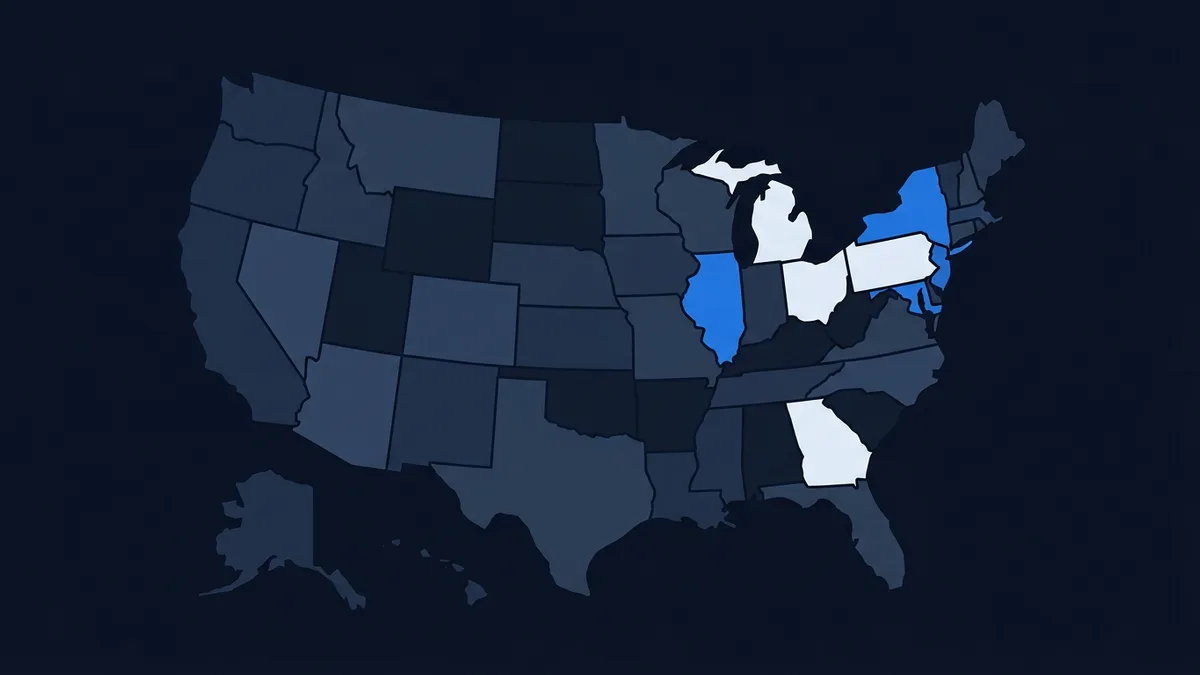
Market note, added 29 August 2026. The Senate figure below is dated 15 August and is left as it was written. Since publication that market has not settled down: Democrats have crossed 50% four more times, on 18, 23 and 27 August, and have traded in a range of 49.5% to 52.5% throughout. As of 29 August the price is 50.5%, still nominally a Democratic favourite and closer to a coin flip than the 52.5% recorded here. The frequency is the point rather than the level: a market that changes sides four times in a fortnight is telling you the same thing the paragraph below says, which is how little it takes to move it. The House figure has not been re-checked and is dated the same way. For prices that are not dated to a day in August, our 2026 midterms hub tracks the Senate and governor races and updates through the day.
For the current prices on control of the House and Senate, see our 2026 midterm election prediction markets piece.
We might still be months away from Americans going to vote, but the 2026 US midterm elections prediction markets have already been busy pricing up what could happen.
The current markets offer an early snapshot of where traders see the balance of power, but the experience of the 2024 presidential election shows just how quickly those probabilities can change when new information emerges.
During that campaign, prediction markets reacted sharply to major political developments including Joe Biden's withdrawal from the race and the live TV presidential debates.
The 2024 election provides a useful guide to how midterms prediction markets could behave, and how prediction markets work with traders on the lookout for as polling, candidate announcements, fundraising, economic data and unexpected political developments begin to reshape the race.
Deposit $20, get $50 to trade
Welcome bonus on the world's largest prediction market.
18+ · New users only · Availability and terms vary by region · Trading involves risk of loss · BeGambleAware.org
Prediction markets assign a meaningful probability to an outcome before it’s the mainstream consensus
Joe Biden was eventually left with little choice but to abandon his 2024 presidential campaign after a disastrous sequence of events in his battle with Republican candidate Donald Trump.
Although Biden's withdrawal appeared relatively sudden to much of the public, US presidential election prediction markets had been pricing the possibility for months.
Polymarket's Biden dropout market launched in September 2023 and ultimately attracted more than $21 million in trading volume. For much of the period before the first presidential debate, the probability of Biden leaving the race remained in the mid-20% range.
While that itself wasn’t a prediction of withdrawal, it was a far higher probability than had been seen before, particularly given that it had never happened in US politics, and offered a meaningful indication that withdrawal from the race was viable. (https://news.polymarket.com/p/gradually-then-suddenly-the-definitive)
In February 2024, Special Counsel Robert Hur's report on Biden's handling of classified documents described the president as a ‘sympathetic, well-meaning, elderly man with a poor memory’ and drove a huge spike in that prediction market from the mid-20s to 37%. (https://www.justice.gov/storage/report-from-special-counsel-robert-k-hur-february-2024.pdf)
By the time of the first televised head-to-head debate with Trump on June 27, the market had recalibrated, with the probability of Biden withdrawing from the presidential race falling to 18.5%.
However, that all changed drastically after the debate. Biden's performance drew immediate calls from within his own party for him to leave the race, and the New York Times editorial board urged him to withdraw days later, prompting a sharp reassessment of his prospects.
The probability of him leaving the race rose substantially to a high of 42% within 24 hours, before remaining elevated for a prolonged period. It eventually climbed as high as 82%, even while Biden continued to publicly insist he would remain the Democratic nominee.
The market did not know what would happen at any stage. It merely continually assessed all probabilities and likelihoods as variables changed. In Biden's case, the market wasn't saying he would definitely withdraw. It was recognising that his candidacy carried a meaningful risk of collapse and rapidly increased that probability when new evidence arrived.
The mid-20% probability was significant because it assigned a meaningful chance to an outcome that remained largely outside the mainstream political conversation.
Markets can disagree with the polling consensus
The 2024 presidential race provides another example of prediction markets diverging from the wider political narrative.
As Biden’s campaign unravelled and he was eventually replaced by Vice President Kamala Harris, Polymarket increasingly favoured Donald Trump, even as national and swing-state polling continued to describe the race as extremely close. (https://www.nytimes.com/2024/10/15/business/dealbook/prediction-markets-trump-harris.html)
By October 17, polymarket.com and Kalshi were both pricing Trump at roughly 55–56% to win, despite polling continuing to show an extremely close race.
Prediction markets then increasingly moved in Trump's favour as the November 5 Election Day approached.
On October 19, The Washington Post reported polymarket.com gave Trump a 60% chance of winning, compared with 40% for Harris, while its polling average showed Harris holding a two-point national lead. (https://www.washingtonpost.com/technology/2024/10/19/election-betting-trump-harris-odds-polymarket-predictit/)
Ten days later, Bloomberg reported that Trump's polymarket.com probability had climbed to 66.4%, despite polls still showing a close race. (https://www.bloomberg.com/news/videos/2024-10-29/1-of-polymarket-bettors-are-boosting-trump-s-odds-video)
Trump ultimately won the election, meaning the US presidential election winner prediction market's increasingly favourable assessment of his chances proved correct. But in isolation, that does not demonstrate prediction markets were superior to polling or forecasting models.
The prediction markets didn’t necessarily have better information than everyone else. What they had was a mechanism that repriced continuously, and in this case that mechanism produced a Trump probability substantially above 50% while much of the conventional political conversation remained focused on a near 50-50 race.
It is worth being precise about what that mechanism was doing, because the Bloomberg segment above is not a story about the wisdom of crowds. Its title is that 1% of Polymarket bettors were boosting Trump's odds, and days earlier Polymarket had confirmed that a single French trader, operating four accounts, had staked around $45 million on the Trump side and sat among the largest holders on that side of the book. The market reached the right answer. It did not reach it by aggregating thousands of views. A concentrated position and a correct forecast are not the same claim, and 2024 is a case where both happened to be true at once.
The 2026 midterms are already being priced
The early market picture suggests a potentially significant shift in the balance of power, with Democrats strongly favoured to take the House but facing a much tougher battle for control of the Senate.
As of 15 August, polymarket.com gives Democrats an 87.5% chance of winning the House and a 52.5% chance of winning the Senate (https://polymarket.com/predictions/midterms).
That difference between the two chambers is important, and the Senate side of it moved while this piece was being prepared. Republicans led that market through the first part of August and were still ahead on 11 August, with Democrats on 46.5%. Democrats crossed 50% on 12 August, reached 52.5% on 13 August, and the price has not moved since. So the Senate is now nominally a Democratic favourite, but at 52.5% it remains close to a coin flip, and a market that reprices six points in two days and then sits still is telling you how little it takes to move it rather than how confident it has become.
Polymarket's Senate market (https://polymarket.com/event/which-party-will-win-the-senate-in-2026) has traded $3,867,073 across its lifetime, of which $21,227 came in the 24 hours to 15 August. Its House market (https://polymarket.com/event/which-party-will-win-the-house-in-2026) has traded $9,390,320 over its lifetime and $5,412 in the same 24 hours. Those daily figures are worth reading alongside the probabilities: the House market carries more than nine million dollars of lifetime turnover, but it printed 87.5% on a day when barely five thousand dollars changed hands. Kalshi also lists midterms markets (https://kalshi.com/category/elections/midterms).
What could move the markets next?
The biggest market moves are likely to come when several pieces of information point in the same direction. A single poll may have little impact, but a strong run of polling, a well-funded candidate and favourable special-election results could collectively change the probability of a party winning a particular seat, and potentially feed into the broader House or Senate control markets.
Polling will also remain important, but it will be only one part of the information being processed by traders. Fundraising, endorsements, retirements, special-election results and economic data could all shift expectations.
Developments involving the Trump administration could be particularly important, with presidential approval, policy decisions, economic conditions and major political controversies potentially affecting both individual races and the broader congressional picture.
That is what makes prediction markets particularly useful to follow over an election cycle. They are not a one-off forecast made months before voters go to the polls. They are continuously updated probabilities, giving traders a live assessment of how the perceived likelihood of an outcome changes as new information arrives.

Prediction markets are probabilities, not predictions
A lesson from the 2024 election is that prediction markets should not be treated as crystal balls. A market giving an outcome a 70% probability is not saying that it will happen; it is saying that, based on the information available at that moment, traders believe it has roughly a seven-in-ten chance of happening.
That distinction matters as the 2026 midterms develop. Today's probabilities will change as candidates are selected, polls arrive, economic conditions shift and unexpected political events reshape the race. A market can be wrong about an individual outcome while still having accurately reflected the level of uncertainty at the time.
The value is therefore in watching how and why probabilities move, rather than simply looking for a winner. The 2024 election showed how quickly prediction markets can absorb new information. The 2026 midterms will provide another live test, with hundreds of individual races and months of new information still to come.