Only a few of the 2026 governor prediction markets appear to be truly competitive races, with the vast majority pricing one candidate or party at an 80%+ implied probability of success.
Kalshi and polymarket.com broadly agree on many of the leading outcomes, but differences between the two markets can reveal where uncertainty remains highest.
This analysis focuses on the most competitive 2026 governor races, comparing Kalshi and polymarket.com prices and identifying the states where market expectations could shift most as the election approaches.
How we choose the markets shown here. We include a race only where both venues' own rulebooks have been read and agree that the two contracts ask the same question. Pairs that survive that are further checked for quantifier mismatches — "at least 24" and "exactly 24" are different claims — and refused where a near-duplicate leg suggests the two venues are pricing different people. Prices are shown only while our reading of them is recent enough to stand up. We do not filter on volume, and the races highlighted are selected by how far the two venues disagree, not by how much has traded.
For the latest prices across individual governor races, control of Congress and much more head iPredicta's US Midterms prediction markets resource.
Deposit $20, get $50 to trade
Welcome bonus on the world's largest prediction market.
18+ · New users only · Availability and terms vary by region · Trading involves risk of loss · BeGambleAware.org
What do the 2026 governor prediction markets expect?
Going into the midterms, Republicans hold 26 governorships and Democrats 24, and of the 36 governorships being contested in 2026 each party currently holds 18 (Ballotpedia, 10 March 2026, read 23 September 2026). Both are matters of record rather than market readings.
Unlike House and Senate elections, gubernatorial elections do not take place in every state in every cycle. Most states elect governors every four years, while New Hampshire and Vermont hold elections every two years, meaning only 36 states have a gubernatorial contest in 2026.
It makes the prediction-market picture particularly interesting. The starting balance is almost evenly split, but drilling into the 36 individual races reveals a more detailed picture of where control looks relatively settled and where uncertainty remains closer to a 50-50 contest.
What are the closest 2026 governor prediction markets?
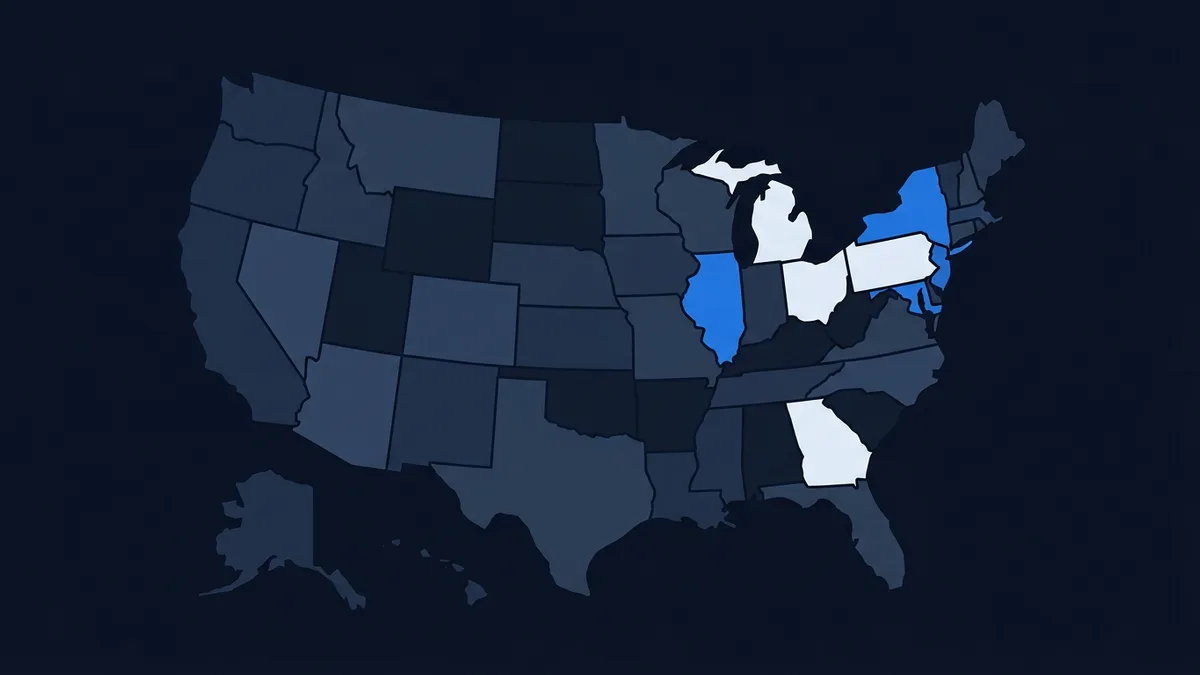
One race currently stands out. Nevada is priced within a point of an even split on polymarket.com, close enough that neither party is favoured in any meaningful sense. Ohio and Georgia are the next most competitive markets on the board, both with a clear but not commanding favourite.
Closest 2026 governor election races
| State | Market leader | polymarket.com | Kalshi | Market gap |
|---|---|---|---|---|
| Nevada | Joe Lombardo (R) | 50.5% | 53.5% | Kalshi +3.0pp |
| Ohio | Amy Acton (D) | 62.0% | 61.5% | polymarket.com +0.5pp |
| Georgia | Keisha Lance Bottoms (D) | 59.5% | 56.5% | polymarket.com +3.0pp |
Market snapshot: 16:25 BST, 23 September 2026. Figures are midpoints between each venue's best bid and best ask. These markets move: Georgia shifted four points in the ninety minutes before publication. Prices can change as trading continues.
Kansas is the next-closest market, although it is considerably more one-sided than the three races above at 69.5% for Republican Ty Masterson on polymarket.com and 67.0% on Kalshi.
The two markets remain closely aligned across these races, with three percentage points or less between them in every case.
Kalshi vs polymarket.com: Why do they price the same governor race differently?
A disagreement between polymarket.com and Kalshi does not necessarily mean the markets expect different winners. A gap can instead show that the two platforms place different probabilities on the same outcome, which can be due to differences in market liquidity, order books and the traders active on each platform.
Differences can also arise from the way individual contracts are structured. Some markets price a named candidate, while others use party-level outcomes, and lower-volume markets can be more sensitive to individual trades.
The size of any gaps across the platforms can be useful information, though. A small difference may simply reflect normal variation between two order books, while a larger or persistent gap can highlight a race where the two markets are responding differently to available information.
Learn the differences between Kalshi and Polymarket prediction markets in our guides section.
What could change the 2026 governor prediction markets?
With so few governor races priced relatively near 50-50, there is considerably more scope for movement in states such as Nevada, Ohio and Georgia than in markets where one candidate is already a heavy favourite.
New polling, candidate activity and state-specific issues could all move individual markets as election day approaches. Wider changes in the national political mood could also affect several races at once, although governor contests can behave differently from congressional elections because candidates and local issues vary significantly from state to state.
For example, in Ohio, data-centre development and rising property taxes have emerged as significant issues in the governor's race. Comments from the candidates and public reaction around issues such as these can influence how traders assess the race and the wider outlook for the contest.
Given the closeness in the overall balance of power across the 36 governorships being contested, a shift in market leadership across the tightest races could alter which party is priced to hold the most after the midterms.

What do the 2026 governor markets tell us?
The 2026 governor prediction markets currently point to a relatively narrow group of competitive races, with Nevada the only contest priced close to an even split.
But the individual markets show where that picture could yet change, particularly in Nevada, Ohio and Georgia.
Tracking the gap between Kalshi and polymarket.com can provide another useful signal as the election approaches, particularly if the two markets begin to move in different directions or previously settled races become more competitive.
For the latest prices across individual governor races, control of Congress and other 2026 election markets, visit iPredicta's US Midterms prediction markets page.
polymarket.com and Polymarket US operate separate order books, so prices can differ between the two platforms. Figures in this article refer to markets on polymarket.com.