David Smith's column in the Guardian opens with a familiar mood: the political operator once called a savant is now, in his critics' telling, floundering. An unpopular war abroad. Grocery prices at home. A press secretary announcing she will step down at the end of the month. If Donald Trump were deliberately trying to sabotage his own party ahead of November, the argument runs, the day-to-day would look much as it does now.
That is the vibe. The prices are quieter, and slightly less certain of themselves. On Polymarket, the Republican Senate seat count market is not treating a Republican wipeout as the base case, but it is not treating a comfortable hold as the base case either. As of 16 August 2026, the single fattest rung on the ladder is the bearish tail: 47 seats or fewer, trading at 26%. Everything else is squeezed into a tight cluster around the status quo.
Deposit $20, get $50 to trade
Welcome bonus on the world's largest prediction market.
18+ · New users only · Availability and terms vary by region · Trading involves risk of loss · BeGambleAware.org
What the market is actually asking
A quick word on the contract itself. It resolves on the Republican Party's Senate seat count after the November 2026 midterms, with runoffs counted even if they slip past election night. It is not a control-of-chamber market and it is not a national-vote-share market. It is a headcount, and the outcomes are integer buckets from 47-or-fewer up to 57-plus.
That matters because it makes the shape of the ladder informative in a way a simple win/lose contract is not. When traders spread their money across a run of neighbouring rungs, they are telling you they see a range of plausible outcomes; when they pile onto one number, they are telling you they think they know. Right now the money is doing the first thing.
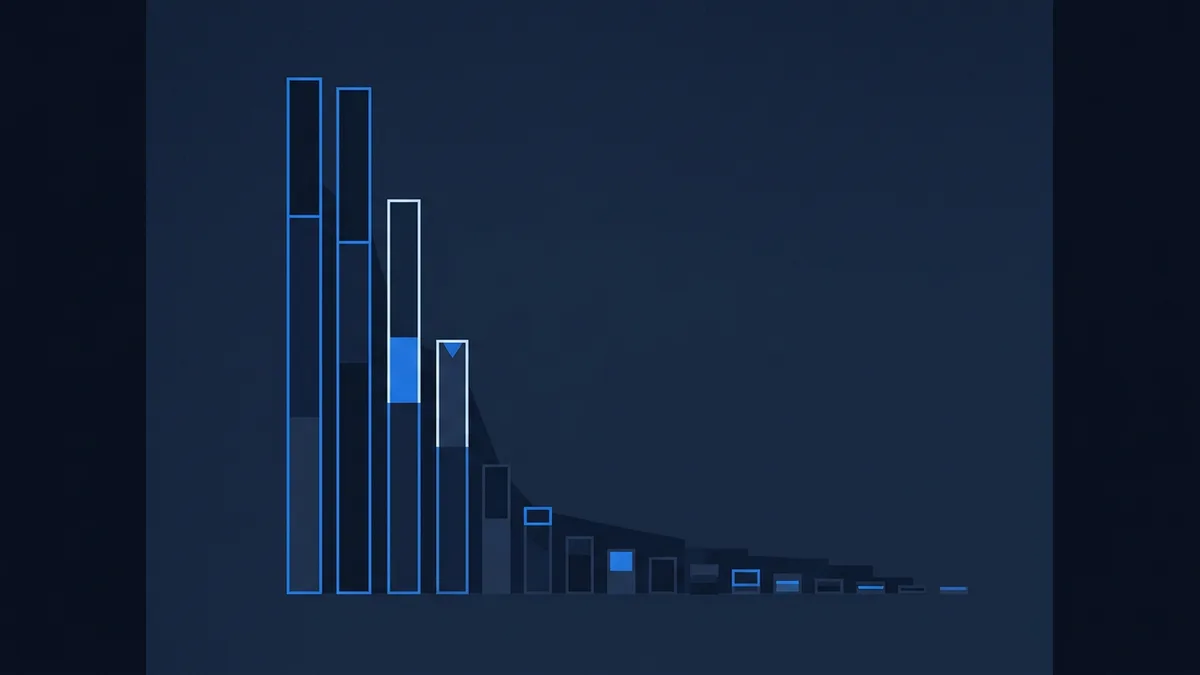
Here is the current picture. The 47-or-fewer bucket sits at 26%. Then comes 51 at 15%, 49 at 13%, 50 at 12%, 48 at 12%, and 52 at 9%. That reconciles with the separate contract on Senate control, which is worth stating because the two are easy to read as contradictory. Republicans at 49 seats or fewer means Democratic control, and those rungs sum to 51.5%; the control market prices Democrats at 50.5%. Within a point of each other, from two different books. Above that the probabilities thin out fast, with 53 at 4%, 54 and 55 at 3% each, and the top of the ladder trading in pennies. Read the cluster and you get a market that thinks the most likely landing zones are either a mild bleed from the status quo or a genuinely bad night, with a clean Republican gain as a real but distinctly minority scenario.
Why the bearish tail is the story
The striking feature is not that 51 is the plurality single-number outcome. It is that the open-ended bearish bucket beats it comfortably, at 26% against 15%. That tells you traders see more distribution risk on the downside than the upside. The top of the ladder, the 55-plus range where a Republican rout would live, barely registers. The bottom, where a Democratic wave would live, is thick.
Does the Guardian column's diagnosis explain that shape? Partly. A war grinding on unpopularly, prices that voters feel every week at the till, and a communications operation described as looking for its next spokesperson are all classic midterm drag on the party in the White House. This is the kind of environment where the base does not turn out and the marginal suburban voter punishes the incumbent by default. None of that is new to political science, and none of it needs Trump to be a uniquely broken operator to bite.
What the market is not doing is calling the election. A 26% chance of 47 or fewer is a real risk, not a prediction; three quarters of the probability mass sits somewhere else. If you have spent time with how prediction market odds work, you already know the trap: the fattest bucket on a laddered contract is not the same thing as a forecast, it is the market's best guess at where the biggest single slice of outcome space sits.
Where prediction markets fit against the polling story
Columns like Smith's lean heavily on approval numbers and vibes reporting. Markets do something different: they aggregate the money views of people willing to be wrong in public. The two are not substitutes, and it is worth being honest about that; markets have been sharper than polls in some cycles and worse in others, and the debate over prediction markets versus polls is not settled by any single midterm.
What the Polymarket ladder adds is granularity. A poll can tell you a generic ballot is R+2 or D+3. It cannot easily tell you the market's implied distribution across every plausible seat count, or where the tail risk sits. For a midterm where the story is unusually about downside for the incumbent party, that distribution shape is arguably more useful than another topline number.
One caveat worth flagging. Turnover on this specific contract is light for a US political market, at $2,630 over the last day against $2,824,750 across the contract's life. That is not nothing, but it does mean single trades can move rungs, and readers should weigh the ladder as a directional read rather than a deeply liquid signal. Our broader coverage of the 2026 midterm prediction markets tracks the higher-volume contracts alongside this one.
iPredicta surfaces prediction markets across Polymarket, Kalshi and the regulated venues, with editorial context on how each contract resolves and what the current lean actually implies. The Republican Senate seat ladder is on the watch list for the same reason the Guardian's column is worth reading: the midterms are the next big real-world stress test for whether the political operator's touch has faded, and the money is not yet ready to commit either way.

Frequently asked questions
What does Polymarket's Republican Senate seat market actually resolve on?
It resolves on the Republican Party's seat count in the US Senate after the November 2026 midterms, covering all regular and special elections that determine the 120th Congress. Runoffs count toward the relevant seat even if they take place after November. Traders pick from integer buckets ranging from 47 or fewer up to 57 or more.
Does a 26% probability on the bearish bucket mean the Republicans are expected to lose seats?
Not exactly. 26% is the fattest single rung, and it is nowhere near a majority: the rest of the probability is spread thinly across every other seat count on the ladder. What it tells you is that traders see meaningful downside risk for the incumbent party, more than they see upside; a genuine forecast would require one bucket to dominate the ladder, and no bucket does.